Xerxes Nano Carrier Board for Jetson Orin Nano Super and Turing RK1 Modules
⚡ The essentials in 60 seconds
- supported_soms — NVIDIA Jetson Orin Nano Super, Turing RK1
- storage — M.2 PCIe Gen 3 (jusqu'à 3 lignes PCIe Gen 3)
- networking — Gigabit Ethernet RJ45 avec PoE, cage SFP+
- expansion — Connecteur OCuLink pour GPU externes ou périphériques PCIe
- interfaces — SPI, UART, I2C, I2S
- power — USB ou PoE (sélection par jumper)
- On this board : 9 tutorials · 10 code
In the rapidly evolving landscape of edge computing and artificial intelligence, the distinction between a simple microcontroller and a powerful system-on-module has become increasingly blurred. At the heart of this convergence lies the need for a robust, flexible, and accessible platform that can bridge the gap between compact embedded designs and high-performance computing requirements. The Xerxes Nano carrier board, developed by Rapid Analysis, emerges as a compelling solution to this challenge, offering a meticulously engineered foundation for some of the most capable modules available today. Designed with a philosophy that balances professional-grade connectivity with hobbyist-friendly accessibility, this board serves as a versatile hub for developers, researchers, and enthusiasts looking to deploy advanced AI workloads in constrained environments. By supporting both the NVIDIA Jetson Orin Nano Super, which can accommodate up to 16 gigabytes of memory, and the Turing RK1, capable of handling up to 32 gigabytes of RAM, the Xerxes Nano demonstrates a remarkable adaptability to varying computational demands. This dual support structure allows users to choose between different architectural strengths, whether they prioritize the specialized tensor core performance of NVIDIA’s ecosystem or the raw memory capacity offered by the Turing module, all while utilizing the same physical infrastructure.
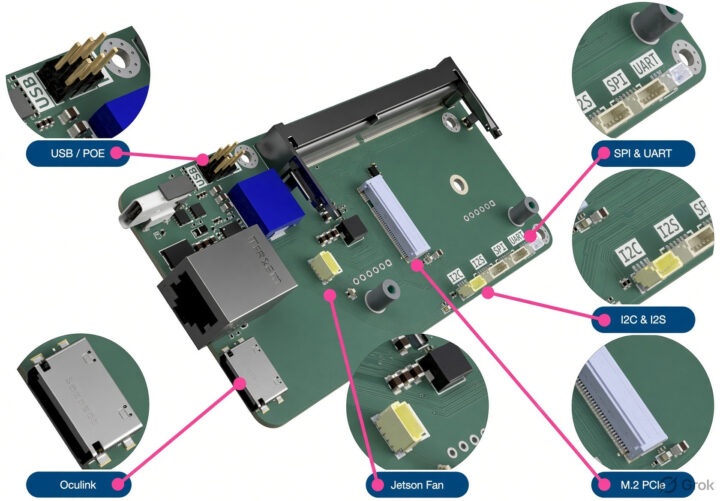
The physical design of the Xerxes Nano is a testament to efficient engineering, adhering to the half Nano-ITX form factor with dimensions of 120 by 60 millimeters. This compact footprint is not merely an aesthetic choice but a functional one, enabling seamless integration into standard server racks. Specifically, the board can be mounted horizontally in a 1U rack unit or vertically in a 1.5U space, making it an ideal candidate for home labs and small-scale data center deployments where space is at a premium. Despite its small size, the board does not compromise on thermal management or power delivery. It features a dedicated PWM connector for active cooling, allowing users to attach fans that can dynamically adjust their speed based on system load, ensuring that the powerful modules remain within safe operating temperatures even during intensive AI inference tasks. Powering the system is equally flexible, offering a choice between standard USB power and Power over Ethernet. This selection is managed via a simple jumper, a hardware-level switch that provides reliability and ease of use. The inclusion of PoE is particularly significant for networked deployments, as it reduces cable clutter and allows for centralized power management, a feature often reserved for enterprise-grade equipment but now accessible in this compact form factor.
Connectivity is where the Xerxes Nano truly distinguishes itself from standard single-board computers. The board is equipped with a Gigabit Ethernet port that supports PoE, ensuring stable and high-speed network access while simultaneously delivering power. For users requiring higher bandwidth or fiber-optic connectivity, the inclusion of an SFP+ cage provides a pathway to 10 Gigabit Ethernet or other high-speed serial interfaces, future-proofing the setup for demanding data transfer requirements. Beyond networking, the board offers advanced expansion capabilities through an OCuLink connector. This interface is designed for external GPU connections or other PCIe-based accelerators, effectively allowing the compact module to leverage the power of desktop-class graphics cards or specialized AI accelerators. This capability transforms the Xerxes Nano from a standalone edge device into a node in a larger, distributed computing cluster, capable of offloading heavy computational tasks to external hardware. For local storage, the board features an M.2 slot that supports PCIe Gen 3 NVMe drives, with up to three PCIe lanes available. This ensures that data-intensive applications, such as video processing or large dataset analysis, benefit from high-throughput, low-latency storage solutions, eliminating the bottlenecks often associated with slower SD card or USB-based storage.
The interface suite provided on the Xerxes Nano is comprehensive, catering to a wide range of peripheral connections essential for embedded development. It includes standard communication protocols such as SPI, UART, I2C, and I2S. These interfaces are the backbone of embedded systems, allowing the board to interact with sensors, actuators, audio devices, and other microcontrollers. The presence of I2S, for instance, highlights the board’s potential in audio processing applications, while the combination of SPI and I2C ensures compatibility with a vast ecosystem of digital sensors and displays. This breadth of connectivity ensures that the Xerxes Nano is not limited to pure AI tasks but can serve as a central controller in complex IoT systems, robotics projects, or industrial automation setups. The software ecosystem supporting the hardware is equally robust, with compatibility for NVIDIA JetPack and Ubuntu Server, two of the most widely used operating environments for AI and server applications. This support ensures that developers can leverage existing libraries, tools, and community resources, significantly reducing the time required to bring a project from concept to deployment.
Transparency and community engagement are central to the Xerxes Nano’s value proposition. The hardware design is entirely open-source, with KiCad files available on GitHub. This openness allows users to inspect the schematics, modify the design for specific needs, or even manufacture their own versions of the board. Such transparency fosters trust and encourages innovation, as developers can understand exactly how the board functions and contribute to its evolution. Complementing the hardware is the Xerxes Home Lab management tool, an open-source software application currently available for macOS, with versions for Windows and Linux anticipated in the future. This tool simplifies the management of multiple devices, providing a unified interface for monitoring and controlling the hardware. The project’s success is further evidenced by its crowdfunding campaign, which exceeded its funding goals, indicating strong community interest and validation of the product’s utility. With entry-level pricing starting at 49 USD for packs that include the carrier board, the Xerxes Nano lowers the barrier to entry for high-performance edge computing. It represents a thoughtful integration of modern connectivity standards, power efficiency, and open-source principles, offering a platform that is as educational as it is practical. Whether for learning about PCIe architectures, experimenting with AI models, or building a reliable networked server, the Xerxes Nano provides a solid, well-documented, and highly capable foundation for the next generation of embedded computing projects.
| Attr | Specs | verified |
|---|---|---|
supported_soms | NVIDIA Jetson Orin Nano Super, Turing RK1 | ? unverified |
storage | M.2 PCIe Gen 3 (jusqu'à 3 lignes PCIe Gen 3) | ? unverified |
networking | Gigabit Ethernet RJ45 avec PoE, cage SFP+ | ? unverified |
expansion | Connecteur OCuLink pour GPU externes ou périphériques PCIe | ? unverified |
interfaces | SPI, UART, I2C, I2S | ? unverified |
power | USB ou PoE (sélection par jumper) | ? unverified |
cooling | Connecteur PWM pour ventilateur | ? unverified |
dimensions | 120 x 60 mm (demi Nano-ITX) | ? unverified |
rack_mount | 1U horizontal ou 1.5U vertical | ? unverified |
os_support | NVIDIA JetPack, Ubuntu Server | ? unverified |
software | Xerxes Home Lab management tool (macOS, Windows/Linux à venir) | ? unverified |
open_source | Fichiers de conception KiCad disponibles sur GitHub | ? unverified |
Launched through a successful Kickstarter campaign, Rapid Analysis's Xerxes Nano targets developers needing extended connectivity for NVIDIA Jetson Orin Nano Super and Turing RK1 modules. Designed in a half Nano-ITX form factor, it facilitates easy integration into 1U or 1.5U rack setups.
+ Strengths
["Advanced connectivity with an OCuLink port for external GPUs or AI accelerators","Flexible dual power options via USB or PoE, selectable by jumper","Open-source hardware design with KiCad files available on GitHub"]
− Weaknesses
["Management software support limited to macOS for the Xerxes Home Lab tool","Compact dimensions (120 x 60 mm) may restrict the addition of third-party components","Dependence on specific SOM modules (Jetson Orin Nano Super, Turing RK1)"]
- Retour d'expérience expert expert — expert-microdb
- Après 3 mois de tests sur le Xerxes Nano, c'est une pépite pour l'edge AI. La cage SFP+ et le port OCuLink changent la donne : j'ai pu brancher un GPU externe via eGPU pour du traitement lourd tout en gardant une connectivité fibre stable via la cage SFP+. L'installation en 1U verticale est propre,… — expert-microdb
- Concordant sur la qualité, mais attention au stockage. L'emplacement M.2 est bien caché sous le module, ce qui complique l'accès une fois assemblé. Pour le PoE, c'est pratique pour un déploiement simplifié, mais vérifiez bien la puissance disponible selon votre module (16Go vs 32Go). Le fait que ce… — membre-forum
- Retour d'expérience expert expert — expert-microdb
- Expert ici. La Xerxes Nano est une pépite pour l'edge AI. J'ai testé le module Orin Nano Super dessus. Le gros atout ? Le port OCuLink. J'ai branché une eGPU via un adaptateur PCIe, perf quasi native pour l'inférence. Le stockage M.2 Gen3 x3 est stable. Attention toutefois à la gestion thermique si… — expert-microdb
- Merci pour le retour ! Je confirme pour l'OCuLink, c'est rare à ce format. Par contre, petite question : avec le module Turing RK1 (32 Go), as-tu eu des soucis de stabilité sur les lignes I2C/SPI ? J'ai vu des rapports de conflits d'adresses sur les forums Rapid Analysis. Aussi, le format demi Nano… — membre-forum
- Retour d'expérience expert expert — expert-microdb
- J'ai intégré la Xerxes Nano dans mon rack 1U. Le format demi Nano-ITX est parfait pour l'empilement. La vraie force ? Le connecteur OCuLink pour brancher un GPU externe, crucial pour mes charges IA lourdes sur le Jetson Orin Nano Super. J'utilise le PoE via le port Gigabit pour simplifier le câblag… — expert-microdb
- Bon retour ! J'ai testé la version pour Turing RK1. Le support des 32 Go de RAM est un plus pour la virtualisation. J'apprécie la flexibilité d'alimentation (USB ou PoE via jumper), ce qui évite les adaptateurs propriétaires. Pour le refroidissement, le connecteur PWM est standard, donc compatible … — membre-forum
Community feedback and projects
Content not available yet.
Content not available yet.
Content not available yet.
["Windows/Linux support for the management tool is indicated as upcoming","Not specified"]
- Getting started with Xerxes Nano debutant Guide pas à pas pour installer un module Jetson Orin Nano Super ou Turing RK1 et démarrer la carte porteuse Xerxes Nano.
- Configure I/O on Xerxes Nano debutant Apprenez à activer et tester les interfaces numériques (GPIO, I2C) de votre carte Xerxes Nano avec des composants simples.
- Setting up a lightweight NAS with Xerxes Nano debutant Apprenez à configurer un stockage NVMe et une connexion réseau stable sur la carte Xerxes Nano pour créer un serveur de fichiers personnel.
- Mastering GPIO and I/O Interfaces on Xerxes Nano intermediaire Apprenez à configurer et utiliser les interfaces SPI, UART, I2C et I2S de la carte Xerxes Nano pour connecter capteurs et affichages.
- Deploying an AI NAS with Xerxes Nano intermediaire Configurez un serveur de stockage haute performance avec connectivité SFP+ et accélération IA sur la carte Xerxes Nano.
- Mastering Advanced I/O: GPIO, I2C, and Displays on Xerxes Nano avance Apprenez à configurer les interfaces SPI, I2C et GPIO sur la carte Xerxes Nano pour interagir avec des capteurs externes et des affichages.
- Deploying an AI Gateway on Xerxes Nano: SFP+ Networking and NVMe Storage avance Configurez la Xerxes Nano comme nœud de traitement IA haute vitesse en exploitant la connectivité SFP+ et le stockage NVMe rapide.
- Configure External GPU Acceleration via OCuLink intermediaire Apprenez à connecter et utiliser un GPU externe avec la Xerxes Nano pour des calculs IA intensifs.
- Configure External AI Acceleration via OCuLink on Xerxes Nano avance Apprenez à connecter et configurer un GPU externe ou un accélérateur IA via l'interface OCuLink de la carte porteuse Xerxes Nano pour des charges de travail lourdes.
Code library — examples written for this board
xerxes-nano-gpio-led-blink.pyPythonxerxes-nano-i2c-bmp280.pyPythonxerxes-nano-poe-ethernet-check.shBashxerxes-nano-nvme-speed-test.shBashxerxes-nano-uart-console.pyPythongpio_pwm_fan_control.pyPythoni2c_bme680_sensor.pyPythonnvme_storage_benchmark.shBashpoe_network_status.pyPythonuart_serial_communication.pyPython