Xerxes Pi 2026 Carrier Board for Raspberry Pi CM4/CM5 Modules
⚡ The essentials in 60 seconds
- supported_soms — Raspberry Pi CM4, CM5, and compatible alternatives
- storage — M.2 M-key PCIe Gen 2 x1 socket for NVMe SSDs (underneath), MicroSD slot
- ethernet — Broadcom BCM54210PE Gigabit Ethernet RJ45 port with optional PoE/PoE+
- usb — USB Type-C for power and compute-module boot/recovery operations
- expansion — SH-series Qwiic connector for I2C and I2S peripherals, Mezzanine expansion connector for CSI and HDMI
- debugging — Dedicated SH-series serial debug connector, Boot jumper pin
- On this board : 9 tutorials · 10 code
Imagine a world where powerful computing is not confined to bulky towers or fragile laptops, but instead resides in a slender, elegant strip of circuitry no larger than a standard smartphone. This is the philosophy behind the Xerxes Pi 2026 carrier board, a compact solution crafted by Rapid Analysis that redefines what we expect from embedded systems. Measuring just 120 by 40 millimeters, this board is designed with a vertical orientation in mind, allowing it to slot neatly into a standard 1U rack. This form factor is not merely an aesthetic choice; it is a deliberate engineering decision that maximizes density in server rooms and industrial environments where space is at a premium. By standing upright, the board minimizes its footprint while maintaining accessibility, creating a modular approach to computing that feels both futuristic and practical.
At the heart of this system lies the concept of the System on Module, or SoM. Rather than soldering a processor directly onto the board, the Xerxes Pi 2026 utilizes two high-density, 100-pin mezzanine connectors. These connectors serve as the bridge between the carrier board and the compute module itself. This design supports Raspberry Pi Compute Module 4 and Compute Module 5, as well as compatible alternatives. Think of the compute module as the brain and the carrier board as the nervous system and body. This separation allows users to upgrade their processing power without replacing the entire infrastructure. If a new generation of processors emerges, one can simply swap the module, leaving the robust connectivity of the carrier board intact. It is a sustainable approach to technology that reduces electronic waste and future-proofs investments.
Storage is often the bottleneck in embedded systems, but the Xerxes Pi 2026 addresses this with sophistication. Tucked underneath the main circuitry is an M.2 M-key socket that supports PCIe Gen 2 x1 NVMe solid-state drives. For those unfamiliar with the terminology, NVMe is a protocol designed specifically for high-speed storage, allowing data to be read and written much faster than traditional methods. By placing the drive underneath, the board maintains its slim profile while offering the performance benefits of modern solid-state technology. Additionally, a MicroSD slot is provided for those who prefer the simplicity and portability of flash memory cards, ensuring flexibility for various use cases, from quick prototyping to long-term deployment.
Connectivity is where this board truly shines, particularly in its networking capabilities. It features a Gigabit Ethernet port powered by the Broadcom BCM54210PE chipset. This is not just any network port; it offers optional support for Power over Ethernet, or PoE, including the higher-power PoE+ standard. PoE technology allows a single Ethernet cable to carry both data and electrical power to the device. This eliminates the need for separate power adapters, simplifying installation and reducing cable clutter. For users who prefer traditional power sources, the board also accepts 5V power via a USB Type-C connector. A clever jumper bridge allows users to select between PoE and USB power, providing a fail-safe mechanism and ensuring that the system can operate in environments where only one power source is available. The USB Type-C port also serves a critical role in maintenance, facilitating boot and recovery operations for the compute module.
Expansion and peripheral support are handled through a variety of thoughtful interfaces. The board includes SH-series Qwiic connectors, which are designed for easy daisy-chaining of I2C and I2S peripherals. These connectors simplify the addition of sensors, displays, and audio components, making the board ideal for Internet of Things applications. Furthermore, a dedicated mezzanine expansion connector exposes CSI and HDMI signals. CSI, or Camera Serial Interface, allows for high-bandwidth camera connections, while HDMI enables high-definition video output. This combination makes the Xerxes Pi 2026 suitable for multimedia projects, security cameras, and digital signage, where both visual input and output are required.
For developers and engineers, debugging is a crucial part of the development cycle. The board includes a dedicated SH-series serial debug connector, providing direct access to the system’s console. This allows for real-time monitoring of system messages and error logs, which is invaluable when troubleshooting complex software issues. Additionally, boot jumper pins are provided to control the startup behavior of the compute module, giving users granular control over the boot process. Status LEDs for power, activity, and network connectivity provide immediate visual feedback on the system’s health, allowing for quick diagnostics without the need for external tools.
Thermal management is another critical aspect of high-performance computing. The Xerxes Pi 2026 supports active cooling through a standard PWM fan connector. Pulse Width Modulation allows the system to dynamically adjust the fan speed based on temperature, ensuring quiet operation when idle and maximum cooling when under load. This balance between performance and noise is essential for office and home environments where silence is valued.
Software compatibility is broad and robust. The board works seamlessly with Raspberry Pi OS and Ubuntu Server, as well as other operating systems supported by the underlying compute modules. To further enhance the user experience, Rapid Analysis provides a macOS management application. This tool offers SSH monitoring and Docker container management, allowing users to oversee their fleet of devices from a single interface. This level of software integration lowers the barrier to entry for managing distributed systems, making advanced server management accessible to a wider audience.
The project is rooted in the open-source community, with KiCad design files available on GitHub. This transparency allows hobbyists, educators, and professionals to understand the inner workings of the board, modify it for specific needs, or learn from its design. The launch price on Kickstarter starts at 49 USD for the Gadgeteer package, which includes the board, PoE accessories, and heat sinks. This pricing strategy reflects a commitment to making advanced embedded computing accessible, offering a powerful, compact, and versatile platform for innovation. The Xerxes Pi 2026 is not just a circuit board; it is a gateway to a new era of modular, efficient, and connected computing.
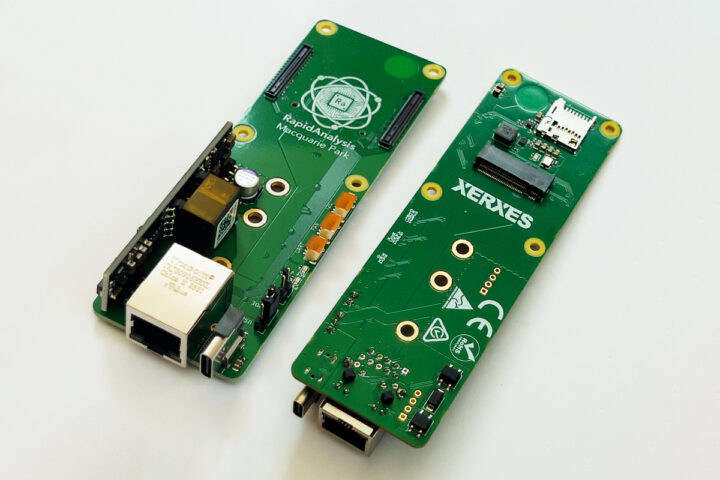
| Attr | Specs | verified |
|---|---|---|
supported_soms | Raspberry Pi CM4, CM5, and compatible alternatives | ? unverified |
storage | M.2 M-key PCIe Gen 2 x1 socket for NVMe SSDs (underneath), MicroSD slot | ? unverified |
ethernet | Broadcom BCM54210PE Gigabit Ethernet RJ45 port with optional PoE/PoE+ | ? unverified |
usb | USB Type-C for power and compute-module boot/recovery operations | ? unverified |
expansion | SH-series Qwiic connector for I2C and I2S peripherals, Mezzanine expansion connector for CSI and HDMI | ? unverified |
debugging | Dedicated SH-series serial debug connector, Boot jumper pin | ? unverified |
power | 5V via USB Type-C or PoE, PoE-to-USB power selection jumper | ? unverified |
dimensions | 120 x 40 mm (fits vertically in 1U rack) | ? unverified |
cooling | Standard PWM fan connector for active cooling | ? unverified |
os_support | Raspberry Pi OS, Ubuntu Server, and other OS supported by compute modules | ? unverified |
connectors | 2x 100-pin high-density mezzanine connectors for SoMs | ? unverified |
leds | Power, activity, and network status LEDs | ? unverified |
Launched by Rapid Analysis via a Kickstarter campaign in 2026, this board targets embedded applications requiring 1U rack integration. The project is open-source with KiCad design files publicly available.
+ Strengths
["- Compact 120 x 40 mm format allowing vertical insertion into a 1U rack.","- Native support for Raspberry Pi CM4, CM5, and compatible alternatives via mezzanine connectors.","- Flexible power supply via USB Type-C or PoE/PoE+ with source selection via jumper."]
− Weaknesses
["- Storage interface limited to PCIe Gen 2 x1 for NVMe.","- Requires specific accessories (PoE, heatsinks) for complete configurations.","- Not specified"]
- Retour d'expérience expert expert — expert-microdb
- Après plusieurs semaines de test, la Xerxes Pi 2026 change la donne pour nos racks 1U. Le format 120x40mm est parfait pour l'insertion verticale. J'ai installé un CM5 avec un NVMe via le slot M.2 sous la carte : le gain de performance est immédiat. L'alimentation PoE+ via le BCM54210PE est stable, … — expert-microdb
- Bon retour. Petite précision sur le refroidissement : le connecteur PWM est bien présent, mais assure-toi de vérifier la compatibilité du ventilateur avec le CM4/CM5 avant d'assembler. J'ai eu un souci mineur avec les dissipateurs inclus dans le pack Gadgeteer, légèrement trop hauts pour certains b… — membre-forum
Community feedback and projects
- Discussions Reddit — Xerxes Pi 2026 reddit.com
- Articles CNX Software — Xerxes Pi 2026 cnx-software.com
Content not available yet.
Content not available yet.
Content not available yet.
["- Not specified","- Not specified","- Not specified"]
- First Connection and Boot of the Xerxes Pi 2026 debutant Guide pas à pas pour installer votre module Raspberry Pi, connecter l'alimentation et vérifier le premier démarrage de la carte Xerxes Pi 2026.
- Getting started with GPIO on Xerxes Pi debutant Apprenez à contrôler une LED et lire un bouton via les broches GPIO exposées sur la carte Xerxes Pi.
- Set up a secure file server with Xerxes Pi 2026 debutant Apprenez à exploiter le stockage NVMe et le réseau Gigabit de la Xerxes Pi 2026 pour créer un NAS personnel performant et accessible.
- Getting Started with Xerxes Pi 2026 intermediaire Guide étape par étape pour assembler, alimenter et démarrer votre carte Xerxes Pi 2026 avec un module Raspberry Pi CM4/CM5.
- Configure Xerxes Pi 2026 I/O intermediaire Apprenez à interfacer des capteurs et afficheurs via les connecteurs Qwiic et mezzanine de la carte Xerxes Pi 2026.
- Deploy a compact NAS with Xerxes Pi 2026 and PoE intermediaire Configurez un serveur de fichiers haute performance utilisant le stockage NVMe et l'alimentation PoE sur la carte Xerxes Pi 2026.
- Xerxes Pi 2026: Advanced I/O Mastery via Qwiic and GPIO avance Configurez des périphériques I2C et GPIO critiques sur la Xerxes Pi 2026 en exploitant les connecteurs Qwiic et les broches de démarrage pour un débogage matériel fiable.
- Deploying a High-Performance NAS and Network Server on Xerxes Pi 2026 avance Configurez la Xerxes Pi 2026 comme nœud de stockage NVMe rapide et passerelle réseau PoE pour une infrastructure homelab robuste.
- NVMe Optimization and PoE Thermal Management avance Configurez le stockage NVMe M.2 et la gestion thermique avancée pour maximiser les performances sous charge PoE.
Code library — examples written for this board
poe-status-monitor.pypythonnvme-benchmark.shbashqwiic-bme280-reader.pypythonpwm-fan-control.pypythonethernet-poe-config.shbashnvme_storage_benchmark-6.inobashgigabit_eth_poe_monitor-7.inopythonqwiic_i2c_scanner-8.inopythonactive_cooling_pwm_control-9.inopythonserial_debug_console-10.inobash