Seeed Studio XIAO STM32C5
⚡ The essentials in 60 seconds
- soc — STMicroelectronics STM32C5A3CG
- cpu — 144 MHz Arm Cortex-M33 with FPU and DSP
- ram — 256KB SRAM
- storage — 1MB internal flash, 16MB external flash
- can_bus — 2x CAN FD controllers (FDCAN1, FDCAN2), 1 onboard transceiver (TCAN3403-Q1)
- sensors — LSM6DS3TR-C 6-axis IMU with programmable heating
- On this board : 9 tutorials · 5 code
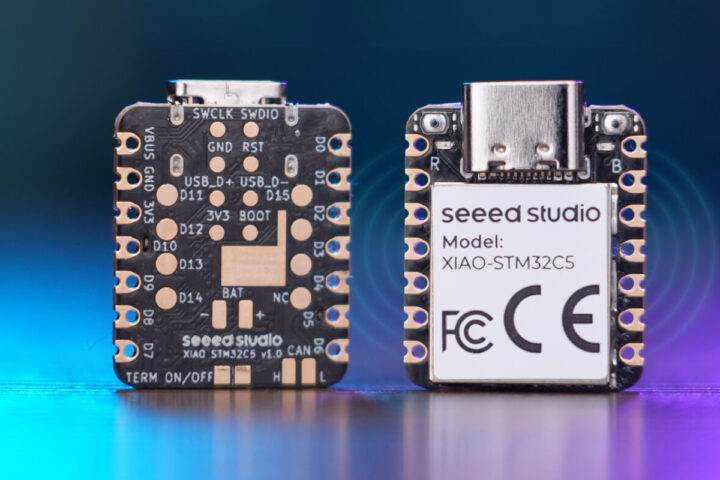
For many years, the Seeed Studio XIAO family has been synonymous with the ESP32 and nRF series, offering developers a compact, thumb-sized platform for Internet of Things projects. The introduction of the Seeed Studio XIAO STM32C5 marks a significant departure from this tradition, representing the first time this popular form factor has been built around a microcontroller from STMicroelectronics. Specifically, this board utilizes the STM32C5A3CG system-on-chip, a component that brings the robust ecosystem of Arm Cortex-M architecture to the ultra-compact XIAO footprint. This shift is not merely a change in branding but a fundamental rethinking of what a small development board can achieve, particularly for applications requiring real-time control, industrial communication protocols, and precise motion sensing. By integrating a processor that is typically found in larger, more complex industrial modules, Seeed Studio has effectively shrunk the capabilities of a professional-grade embedded system into a package measuring just 21 by 17.8 millimeters, allowing engineers to prototype sophisticated control systems without the bulk of traditional development kits.
At the heart of this board lies the Arm Cortex-M33 core, a processor architecture that represents the modern standard for embedded computing. Unlike older cores, the Cortex-M33 includes hardware support for floating-point operations and digital signal processing, which means it can handle complex mathematical calculations much faster than its predecessors. This core runs at a clock speed of 144 MHz, providing ample processing power for tasks that require quick reaction times, such as motor control or sensor fusion. To support this processing capability, the chip is equipped with 256 kilobytes of SRAM, which serves as the fast, temporary workspace for the processor while it executes code. For long-term storage, the board features 1 megabyte of internal flash memory, where the operating system and application code reside. However, recognizing that modern applications often need to store large amounts of data, such as logging sensor readings or storing firmware updates, the board also includes 16 megabytes of external flash memory. This substantial storage capacity ensures that developers are not limited by the internal memory constraints of the microcontroller itself.
One of the most distinctive features of the STM32C5 variant is its dual CAN FD controller capability, a feature that sets it apart from many other hobbyist-oriented boards. CAN, or Controller Area Network, is a communication protocol widely used in automotive and industrial environments to allow different electronic control units to communicate reliably in noisy environments. The "FD" stands for Flexible Data-rate, which allows for faster data transmission compared to the older CAN standard. The board implements this through two separate controllers, known as FDCAN1 and FDCAN2. To make this immediately usable, the FDCAN2 controller is connected to an onboard transceiver, specifically the Texas Instruments TCAN3403-Q1, which includes a built-in 120-ohm termination resistor. This means that for many applications, a developer can connect the board directly to a CAN bus without needing additional external components. The second controller, FDCAN1, is exposed on the headers but requires an external transceiver, offering flexibility for designs that need to isolate the bus or use different physical layer standards. This dual-channel approach allows the board to act as a gateway between two different CAN networks or to communicate with multiple devices simultaneously, a capability that is highly valuable in robotics and industrial automation projects.
Complementing the communication capabilities is an integrated 6-axis Inertial Measurement Unit, the LSM6DS3TR-C. An IMU combines an accelerometer, which measures linear acceleration, and a gyroscope, which measures rotational velocity, to provide a comprehensive picture of the board’s movement and orientation. This sensor is particularly interesting because it includes a programmable heating circuit controlled via Pulse Width Modulation. In precision motion tracking, temperature changes can cause the sensor’s readings to drift, leading to inaccuracies over time. By actively heating the sensor to a stable temperature, the board minimizes this thermal drift, ensuring that the data remains consistent even if the ambient environment fluctuates. This level of engineering detail suggests that the board is designed not just for simple motion detection, but for high-precision applications such as drone stabilization, gesture recognition, or industrial vibration analysis, where data integrity is paramount.
The physical interface and power management of the board are designed for versatility and ease of use in portable applications. Connectivity is handled via a USB Type-C port, which supports USB 2.0 Full-Speed. This modern connector standard simplifies power delivery and data transfer, eliminating the need for older micro-USB cables. For projects that need to operate away from a power outlet, the board includes dedicated pins for connecting a Lithium-ion or Lithium-Polymer battery, along with an integrated charging circuit. This allows the board to be powered by a small, lightweight battery while simultaneously charging it when connected to USB, making it ideal for wearable devices or remote sensors. The board’s expansion capabilities are provided through two sets of 7-pin headers and castellated holes, which allow the module to be soldered directly onto a custom carrier PCB for production designs. Additionally, a Serial Wire Debug interface is available for advanced debugging and firmware flashing.
Software support for the STM32C5 is robust, catering to developers with varying levels of expertise. For those who prefer a graphical, integrated development environment, STM32CubeIDE is fully supported, providing a comprehensive suite of tools for configuring peripherals and generating code. For developers who prefer a more modern, cross-platform approach, the board is compatible with PlatformIO, which includes support for the Zephyr Real-Time Operating System. Zephyr is a scalable RTOS that is increasingly popular in the industry for its security and modularity, allowing developers to build complex, multi-threaded applications efficiently. For rapid prototyping and educational purposes, MicroPython is also supported, enabling developers to write high-level Python code that runs directly on the microcontroller. This combination of hardware features and software flexibility makes the Seeed Studio XIAO STM32C5 a compelling choice for anyone looking to bridge the gap between hobbyist prototyping and professional embedded engineering, particularly in domains that demand reliable communication and precise motion sensing.
| Attr | Specs | verified |
|---|---|---|
soc | STMicroelectronics STM32C5A3CG | ? unverified |
cpu | 144 MHz Arm Cortex-M33 with FPU and DSP | ? unverified |
ram | 256KB SRAM | ? unverified |
storage | 1MB internal flash, 16MB external flash | ? unverified |
can_bus | 2x CAN FD controllers (FDCAN1, FDCAN2), 1 onboard transceiver (TCAN3403-Q1) | ? unverified |
sensors | LSM6DS3TR-C 6-axis IMU with programmable heating | ? unverified |
usb | USB Type-C port, USB 2.0 Full-Speed | ? unverified |
power | 5V via USB-C, 3.7V Li-ion/LiPo battery support with charging circuit | ? unverified |
dimensions | 21 × 17.8 mm | ? unverified |
os_support | STM32CubeIDE, PlatformIO with Zephyr RTOS, MicroPython | ? unverified |
expansion | 2x 7-pin headers, castellated holes, SWD interface | ? unverified |
As the first XIAO series board based on a STMicroelectronics microcontroller, the XIAO STM32C5 introduces the STM32C5A3CG SoC. It combines a 144 MHz Arm Cortex-M33 core with industrial features like dual CAN FD and an actively heated IMU in a compact form factor.
+ Strengths
["- Dual CAN FD controllers with an onboard transceiver (TCAN3403-Q1) and 120 Ω termination resistor on FDCAN2","- 6-axis LSM6DS3TR-C inertial sensor with PWM-programmable heating circuit to reduce thermal drift","- Extensive software support including STM32CubeIDE, Zephyr RTOS via PlatformIO, and MicroPython"]
− Weaknesses
["- The FDCAN1 controller requires an external transceiver to be functional","- USB connectivity is limited to USB 2.0 Full-Speed","- Not specified"]
- Retour d'expérience expert expert — expert-microdb
- J'ai testé la XIAO STM32C5 sur un projet de logging CAN FD. Le TCAN3403 embarqué est un vrai gain de temps : pas de soudure de résistances 120Ω, ça marche direct. Le chauffeur PWM du LSM6DS3TR-C stabilise vraiment les données, crucial pour notre IMU. Par contre, attention, FDCAN1 est nu, il faut aj… — expert-microdb
- Merci pour le retour. Pour ma part, j'utilise Zephyr via PlatformIO. La compilation est fluide grâce aux 256 Ko de SRAM, même avec des stacks BLE complexes. J'apprécie aussi le circuit de charge LiPo intégré, très pratique pour les nœuds autonomes. Par contre, j'ai galéré avec la doc sur le cristal… — membre-forum
Community feedback and projects
Content not available yet.
Content not available yet.
Content not available yet.
["- Not specified","- Not specified","- Not specified"]
- Getting Started with the Seeed Studio XIAO STM32C5 debutant Apprenez à identifier les composants clés et à effectuer le premier branchement USB de la carte XIAO STM32C5.
- Using GPIO and IMU on XIAO STM32C5 debutant Apprenez à contrôler une LED via GPIO et à lire les données du capteur inertielle intégré.
- Simple Automation with the IMU Sensor debutant Découvrez comment lire les données du capteur inertielle pour déclencher une action simple.
- Getting Started and First Connection with the XIAO STM32C5 intermediaire Guide pratique pour la première mise sous tension, la détection du port série et le flashage d'un firmware minimal sur la carte XIAO STM32C5.
- Controlling GPIO and Reading the IMU on XIAO STM32C5 intermediaire Apprenez à configurer les broches GPIO et à lire les données du capteur inertielle LSM6DS3TR-C intégré.
- Log CAN FD Data on XIAO STM32C5 intermediaire Configurez le bus CAN FD pour capturer et stocker des trames de données sur le stockage externe de la carte.
- Advanced First Boot for XIAO STM32C5 avance Guide technique pour initialiser le XIAO STM32C5, valider le cœur Cortex-M33 et configurer les périphériques critiques comme le CAN FD et le capteur LSM6DS3TR-C.
- Master Advanced I/O: GPIO and LSM6DS3TR-C Sensor avance Configurez les GPIO rapides et interrogez le capteur inertielle intégré via I2C sur la XIAO STM32C5.
- Industrial Automation: CAN FD Logging and PWM Control on XIAO STM32C5 avance Ce tutoriel démontre l'intégration du bus CAN FD et de la gestion thermique du capteur LSM6DS3TR-C pour une application d'enregistrement de données robuste.