M5Stack PaperDIY Complete Kit ESP32-S3 e-paper Development Kit
⚡ The essentials in 60 seconds
- soc — Espressif Systems ESP32-S3-WROOM-1-N16R8 (Dual-core LX7, 240MHz)
- ram — 512KB SRAM, 8MB Octal PSRAM
- storage — 384KB ROM, 16MB Flash, slot MicroSD
- wifi_bluetooth — WiFi 4 802.11b/g/n, Bluetooth 5.0 LE
- display — 4.7 pouces ED047TC1 e-paper, 960x540, 16 niveaux de gris
- display_interface — Interface parallèle 8 bits
- On this board : 9 tutorials · 10 code
The M5Stack PaperDIY Complete Kit represents a significant evolution in the realm of low-power, portable electronic development platforms, arriving in October 2026 as the direct successor to the well-regarded M5Paper model originally released in 2020. This latest iteration is designed for makers, educators, and hobbyists who seek a balance between computational power and energy efficiency, particularly for applications that rely on static display information rather than rapid, high-frame-rate animations. At the heart of this development board lies the ESP32-S3-WROOM-1-N16R8 module, a sophisticated system-on-chip solution from Espressif Systems. This module integrates a dual-core LX7 processor, capable of operating at clock speeds up to 240 MHz. For those new to embedded systems, a dual-core architecture allows the device to handle multiple tasks simultaneously, such as maintaining a network connection while updating the display or processing sensor data, without experiencing the lag or freezing that might occur on single-core alternatives. The LX7 cores are specifically optimized for high-performance computing within low-power constraints, making them ideal for battery-operated devices that still require robust processing capabilities.
Memory management is a critical aspect of any microcontroller-based project, and the PaperDIY Complete Kit is well-equipped to handle complex applications. It features 512 KB of static random-access memory, commonly known as SRAM, which provides fast, temporary storage for active program variables and real-time data processing. To complement this, the board includes 8 MB of Octal PSRAM, or Pseudo-Static Random-Access Memory. This external memory expansion is crucial for projects that require larger buffers for image processing, web server hosting, or complex user interfaces, as it allows the system to store more data than the internal SRAM could hold on its own. Additionally, the module contains 384 KB of Read-Only Memory, which stores the essential boot instructions and low-level system routines required to start the device. For long-term data storage, the kit provides 16 MB of Flash memory, where the user’s code and persistent data are saved, ensuring that information remains intact even when the power is turned off. For users needing even more storage capacity, perhaps for logging extensive sensor data or storing large media files, the board includes a dedicated slot for a MicroSD card, offering a flexible and expandable solution for data retention.
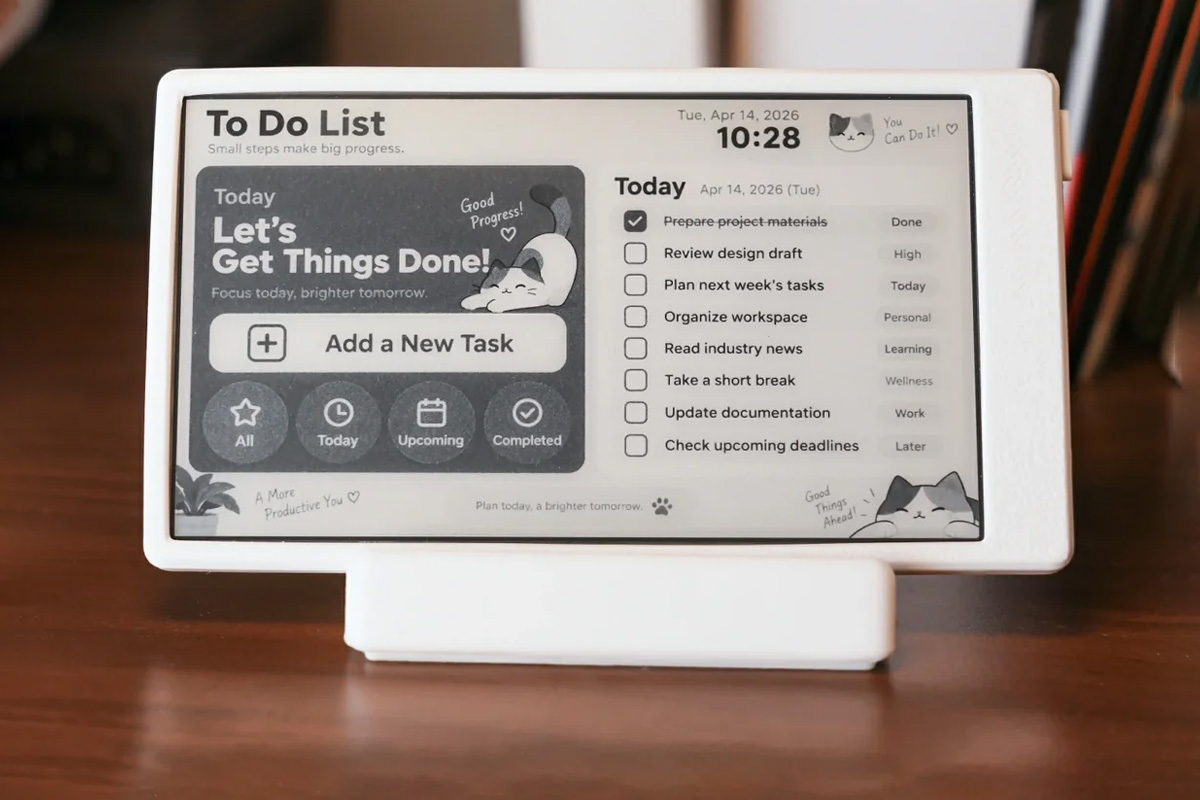
The defining feature of the PaperDIY Complete Kit is its display technology, which sets it apart from traditional LCD or OLED screens found on many other development boards. It utilizes a 4.7-inch e-paper display, specifically the ED047TC1 model, which offers a resolution of 960 by 540 pixels. E-paper, or electronic paper, technology mimics the appearance of ordinary ink on paper, providing excellent readability even under direct sunlight and from wide viewing angles. Unlike conventional displays that require constant power to maintain an image, e-paper screens only consume energy when the image is being updated. Once an image is displayed, it remains visible without any power consumption, a feature that dramatically extends battery life in applications where the screen content changes infrequently, such as digital signage, e-books, or status monitors. This particular display supports 16 levels of grayscale, allowing for rich, detailed images with subtle shading, rather than just simple black-and-white text. The display is controlled via an 8-bit parallel interface, a communication method that allows for faster data transfer rates compared to serial interfaces, ensuring that screen updates occur promptly when changes are needed.
Wireless connectivity is seamlessly integrated into the board, enabling it to function as an Internet of Things node. The kit supports WiFi 4, adhering to the 802.11b/g/n standards, which provides reliable connectivity for most home and office networks. This allows the device to send data to cloud servers, receive remote commands, or host a local web interface for configuration. Alongside WiFi, the board features Bluetooth 5.0 Low Energy, or BLE, which is optimized for short-range communication with minimal power consumption. This is particularly useful for pairing with smartphones or other nearby devices for configuration or data transfer without the energy overhead of classic Bluetooth. Both wireless functions are supported by an integrated PCB antenna, eliminating the need for external antenna components and simplifying the physical design of the final product.
Power management is handled by the M5PM1 power management chip, a component specifically designed to optimize energy usage in battery-powered devices. This chip manages the charging of the integrated 140 mAh battery and regulates the power supplied to the various components of the board. By efficiently managing power states, the M5PM1 helps maximize the operational time of the device between charges, which is essential for portable applications. The combination of the low-power e-paper display and the efficient power management system makes the PaperDIY Complete Kit particularly suitable for projects that need to operate for extended periods without frequent recharging.
The kit is available in two distinct versions to cater to different user preferences and project requirements. The Complete Kit, which is the primary focus of this description, comes fully pre-assembled and housed in a sleek, 3D-printed enclosure. This version is ideal for users who want to start developing immediately without the need for soldering or complex assembly, providing a polished, ready-to-use prototype that can be easily integrated into larger projects or used as a standalone device. The 3D-printed case not only protects the internal electronics but also provides a professional aesthetic suitable for demonstrations and end-user products. Alternatively, for those who prefer a more hands-on approach or wish to integrate the electronics into a custom-designed housing, an Assembly Kit version is also available. This variant allows makers to assemble the components themselves, offering greater flexibility for custom form factors and embedded applications. The transition from the M5Paper of 2020 to this new PaperDIY Complete Kit reflects the ongoing advancement in microcontroller technology, offering improved processing power, enhanced memory capabilities, and refined power management, all while maintaining the core philosophy of accessible, low-power electronic development.
| Attr | Specs | verified |
|---|---|---|
soc | Espressif Systems ESP32-S3-WROOM-1-N16R8 (Dual-core LX7, 240MHz) | ? unverified |
ram | 512KB SRAM, 8MB Octal PSRAM | ? unverified |
storage | 384KB ROM, 16MB Flash, slot MicroSD | ? unverified |
wifi_bluetooth | WiFi 4 802.11b/g/n, Bluetooth 5.0 LE | ? unverified |
display | 4.7 pouces ED047TC1 e-paper, 960x540, 16 niveaux de gris | ? unverified |
display_interface | Interface parallèle 8 bits | ? unverified |
battery | 140mAh intégrée | ? unverified |
power_management | Puce M5PM1 basse consommation | ? unverified |
enclosure | Boîtier imprimé en 3D (version Complete Kit) | ? unverified |
predecessor | M5Paper (2020) | ? unverified |
variant | Existe aussi en version Assembly Kit | ? unverified |
antenna | Antenne PCB | ? unverified |
Launched in October 2026, the M5Stack PaperDIY Complete Kit succeeds the M5Paper released in 2020. It offers a pre-assembled solution in a 3D-printed enclosure, featuring a 4.7-inch e-paper display and an ESP32-S3 core module.
+ Strengths
["- 4.7-inch ED047TC1 e-paper display with 960x540 resolution and 16 grayscale levels.","- ESP32-S3-WROOM-1-N16R8 core module with dual-core LX7 up to 240MHz and 8MB Octal PSRAM.","- Shipped pre-assembled in a 3D-printed case, with an Assembly Kit variant available for custom integration."]
− Weaknesses
["- Limited battery capacity of 140mAh.","- Wireless connectivity restricted to WiFi 4 (802.11b/g/n) and Bluetooth 5.0 LE.","- Display interface limited to an 8-bit parallel bus."]
- Retour d'expérience expert expert — expert-microdb
- Après 3 semaines sur le PaperDIY Complete Kit, je confirme qu'il est idéal pour les tableaux de bord IoT. Le ESP32-S3 (240 MHz, 16Mo Flash) gère l'écran e-paper ED047TC1 (960x540, 16 gris) sans lag via l'interface 8 bits. La batterie de 140 mAh est limitée en autonomie, mais la puce M5PM1 optimise … — expert-microdb
- Merci pour ce retour. Je suis d'accord sur la facilité d'intégration grâce au boîtier 3D préassemblé. Par contre, 140 mAh reste faible pour un écran 4,7 pouces. Pour des mises à jour fréquentes, je recommande d'ajouter une carte microSD pour le stockage externe, car les 16 Mo de flash et 8 Mo de PS… — membre-forum
- Retour d'expérience expert expert — expert-microdb
- Après 3 semaines d'utilisation du kit PaperDIY, je suis bluffé par la réactivité de l'ESP32-S3 comparée à l'ancien M5Paper. Les 16 Mo de flash et 8 Mo de PSRAM octal permettent de gérer des UI complexes sans latence. La batterie de 140 mAh est faible, mais la puce M5PM1 optimise bien la veille. Att… — expert-microdb
- Bon retour. Juste une précision sur la connectivité : le WiFi 4 (802.11b/g/n) et le BT 5.0 LE via antenne PCB sont corrects pour des mises à jour OTA, mais ne comptez pas sur une portée immense à cause de la taille de l'antenne. Pour le stockage, l'emplacement microSD est crucial car les 16Mo de fl… — membre-forum
- Retour d'expérience expert expert — expert-microdb
- Après 2 semaines de tests sur le PaperDIY Complete Kit, je suis bluffé par la réactivité du ESP32-S3. Le passage de 80MHz à 240MHz change tout pour le rendu des 16 niveaux de gris sur l'écran ED047TC1. La gestion mémoire (8MB PSRAM) permet de charger des images haute résolution sans lag, contrairem… — expert-microdb
- Merci pour le retour. J'ai opté pour la version Assembly Kit pour l'intégrer dans un boîtier custom. La connectique est bien pensée, mais attention à l'interface parallèle 8 bits : elle est rapide mais consomme plus que le SPI classique. Avec le WiFi 4 et le BLE 5.0, c'est parfait pour un tableau d… — membre-forum
Community feedback and projects
Content not available yet.
Content not available yet.
Content not available yet.
["- Not specified"]
- First connection and startup of M5Stack PaperDIY debutant Guide pas à pas pour allumer, charger et vérifier le fonctionnement de base de votre kit PaperDIY.
- GPIO Control and Display on M5Stack PaperDIY debutant Apprenez à interagir avec les entrées-sorties et l'écran e-paper du M5Stack PaperDIY via des exemples simples.
- Complete Use Case: Weather Dashboard with M5Stack PaperDIY debutant Apprenez à combiner le WiFi, l'écran e-paper et le stockage MicroSD pour créer un tableau de bord autonome affichant la météo locale.
- Getting Started with M5Stack PaperDIY Complete Kit intermediaire Guide étape par étape pour allumer, charger et vérifier le fonctionnement basique de votre kit PaperDIY.
- GPIO Control and E-Paper Display on M5Stack PaperDIY intermediaire Apprenez à piloter les GPIO et à rafraîchir l'écran e-paper ED047TC1 via l'interface parallèle 8 bits.
- Connected Weather Station with M5Stack PaperDIY intermediaire Créez une station météo autonome affichant les données en temps réel sur l'écran e-paper via WiFi.
- Advanced First Boot of M5Stack PaperDIY avance Guide technique pour initialiser le kit PaperDIY, configurer l'environnement ESP32-S3 et valider la chaîne d'affichage e-paper.
- Mastering GPIO and E-Paper Display on M5Stack PaperDIY avance Ce tutoriel avancé détaille le pilotage direct des GPIO et la gestion fine de l'écran e-paper ED047TC1 via l'interface parallèle 8 bits.
- Network Automation and Storage on M5Stack PaperDIY avance Créez un système de surveillance IoT autonome utilisant le WiFi, la MicroSD et l'écran e-paper du kit PaperDIY.
Code library — examples written for this board
gpio_led_button_control.inoC++ (Arduino)epaper_hello_world.inoC++ (Arduino)wifi_scanner.inoC++ (Arduino)sd_card_logger.inoC++ (Arduino)ble_beacon.inoC++ (Arduino)gpio-button-led.inoC++ (Arduino)epaper-hello-world.inoC++ (Arduino)wifi-scanner.inoC++ (Arduino)sd-card-logger.inoC++ (Arduino)deep-sleep-timer.inoC++ (Arduino)