Arduino Nicla Sense ME
⚡ The essentials in 60 seconds
- main_mcu — Nordic Semiconductor nRF52832 — Arm Cortex-M4F (FPU) at 64 MHz, 512 KB internal flash (shared with the bootloader), 64 KB SRAM (store tech specs, datasheet "Microcontroller", tech-specs.yml). The core compiles it with -DARDUINO_ARCH_NRF52832, cortex-m4, upload.maximum_size=527616, upload.maximum_data_size=64288 (ArduinoCore-mbed boards.txt).
- the_nrf52832_is_soldered_as_a_module — it sits inside the u-blox ANNA-B112 Bluetooth module — "Based on nRF52832 from Nordic Semiconductor, allowing you to run your own code (open CPU)", SiP 6.5 × 6.5 × 1.2 mm, Bluetooth 5.0 + Bluetooth Mesh, LE TX +5 dBm EIRP, up to 160 m range, 25 GPIO, 12-bit ADC, supply 1.7–3.6 V, −40…+85 °C (u-blox ANNA-B112 page). On the Nicla the module runs on a 1.8 V rail (datasheet). - Spec conflict: the store tech-spec table says "Bluetooth® 4.2" (store page) while Arduino's own tech-specs file and u-blox say Bluetooth 5.0 (tech-specs.yml, u-blox). The module's silicon (nRF52832) is a Bluetooth 5-capable part; treat "4.2" on the store page as stale.
- no_gpu — (microcontroller board).
- radios — Bluetooth Low Energy only (2400–2483.5 MHz, internal antenna, internal 32 MHz oscillator + external SIT1532AI 32.768 kHz MEMS oscillator); no Wi-Fi, no cellular, no LoRa (datasheet board topology, user manual: "The Nicla Sense ME does not have built-in Wi-Fi").
- memory — 512 KB flash / 64 KB RAM (nRF52832) + 2 MB SPI flash (U7, MX25R1635FZUIH0) for data logging, hosted by the ANNA-B112 over SPI + 2 MB QSPI flash (U2, MX25R1635FZUIH0) dedicated to the BHI260AP for execute-in-place code and BSX fusion calibration data (datasheet, store tech specs).
- sensors_all_bosch_sensortec_per_the_datasheet_s_functional_blocks — - BHI260AP (U5): smart sensor hub with Fuser2, 32-bit Synopsys DesignWare ARC EM4 CPU, integrated 16-bit 6-axis IMU (3-axis accelerometer + 3-axis gyroscope), self-learning AI, pedestrian dead reckoning, swim analytics, orientation; hosts the other sensors and runs the BSX 9-axis sensor-fusion firmware (datasheet, BHI260AP datasheet PDF, cheat sheet — BSX section). - BMP390 (U3): 24-bit absolute barometer, 300–1250 hPa, ±0.5 hPa absolute / ±0.03 hPa relative accuracy, 0.02 Pa RMS noise, 512-byte FIFO, up to 200 Hz; on the BHI260's SPI bus with the BME688 (datasheet, BMP390 datasheet PDF). - BMM150 (U4): 12-bit 3-axis geomagnetic sensor, ±1300 µT (X,Y) / ±2500 µT (Z), 0.3 µT resolution, <1 % FS non-linearity; on a dedicated I²C bus to the BHI260AP (datasheet, BMM150 datasheet PDF). - BME688 (U6): digital low-power gas (eNose, metal-oxide array, typical scan cycle 10.8 s) + integrated high-accuracy pressure (300–1100 hPa), humidity (0–100 %) and temperature (−40…+85 °C) sensing with AI; detects TVOCs, volatile sulfur compounds, CO and H₂ in the ppb range, outputs IAQ, bVOC- and CO₂-equivalents (datasheet, tech-specs.yml, Bosch BME688 product page, BME688 datasheet PDF).
- On this board : 9 tutorials · 10 code
The Arduino Nicla Sense ME is a compact, battery-powered development board designed for advanced sensing applications, particularly in the realm of Internet of Things (IoT) and wireless sensor networks. As part of the Arduino Pro family, this module distinguishes itself by integrating a comprehensive suite of Bosch Sensortec sensors and a powerful microcontroller into a footprint of just 22.86 by 22.86 millimeters, weighing only two grams. This extreme miniaturization makes it ideal for wearable devices, asset tracking, and industrial monitoring where space and power consumption are critical constraints. The board was introduced around late 2020 and remains actively supported, with software updates continuing into 2026, ensuring that developers have access to current tools and libraries.
At the heart of the Nicla Sense ME lies the Nordic Semiconductor nRF52832, a system-on-chip based on the Arm Cortex-M4F architecture running at 64 MHz. This microcontroller is not soldered directly to the board but is embedded within a u-blox ANNA-B112 Bluetooth module. This module provides Bluetooth Low Energy (BLE) connectivity, allowing the board to communicate wirelessly with smartphones, gateways, or other BLE-enabled devices. While some early documentation listed Bluetooth 4.2, the underlying hardware supports Bluetooth 5.0, offering improved range and data throughput. The nRF52832 features 512 KB of flash memory and 64 KB of SRAM, which is sufficient for running complex sensor fusion algorithms and communication stacks. Notably, the board does not include Wi-Fi, cellular, or LoRa radios, positioning it strictly as a short-range wireless node that often pairs with a gateway board for long-range connectivity.
The true strength of the Nicla Sense ME is its sensor array, which is managed by a dedicated smart sensor hub, the Bosch BHI260AP. This component acts as a co-processor, handling data from multiple sensors to offload work from the main microcontroller. The BHI260AP includes an integrated 16-bit 6-axis Inertial Measurement Unit (IMU), combining a 3-axis accelerometer and a 3-axis gyroscope. It also hosts a 3-axis magnetometer (BMM150) for compass readings, a barometric pressure sensor (BMP390) for altitude detection, and an environmental sensor (BME688) that measures temperature, humidity, pressure, and gas quality. The BME688 is particularly notable for its ability to detect volatile organic compounds (VOCs) and other gases, enabling applications like indoor air quality monitoring. The BHI260AP runs Bosch’s BSX sensor fusion firmware, which processes raw sensor data to provide high-level outputs such as absolute orientation, step counting, and activity recognition (e.g., walking, running, or cycling). This on-chip AI capability means that the main processor only needs to read simple, pre-processed data, significantly reducing power consumption and code complexity.
Power management is a key feature of the Nicla Sense ME, designed for efficient battery operation. The board can be powered via Micro-USB, an ESLOV connector, or a single-cell lithium-polymer (LiPo) battery. It includes a TI BQ25120 power management IC that handles charging and battery monitoring. This charger is software-configurable, allowing developers to adjust charging currents and monitor battery voltage and percentage directly from their sketches. The board’s power consumption is optimized for low-power scenarios, with standby currents as low as 460 microamps and typical operating currents under 3 milliamps when actively polling sensors and advertising over BLE. This efficiency supports long battery life, making it suitable for remote deployments. The board also features a 2 MB SPI flash memory for data logging, allowing it to store sensor readings locally when no network connection is available.
Connectivity and integration options are flexible. The Nicla Sense ME can operate as a standalone device, running its own code to collect and transmit data. Alternatively, it can function as a smart sensor peripheral, connecting to a host board like the Arduino Portenta or MKR series via the ESLOV cable or by acting as an I2C slave. This "shield mode" allows the Nicla to serve as a plug-and-play sensor module for more powerful processors. For debugging and programming, the board uses a separate Microchip ATSAMD11 chip that acts as a USB-to-serial bridge and JTAG/SWD debugger. This means that programming is done through the Arduino IDE using the Mbed OS core, with uploads handled via OpenOCD and CMSIS-DAP protocols. Users should be aware that the board’s GPIO pins operate at a 1.8-volt logic level by default, though this can be adjusted via software. Additionally, the analog-to-digital converter (ADC) has a fixed reference voltage of 1.8 volts, meaning inputs above this level will saturate, a crucial detail for analog sensor integration.
The software ecosystem for the Nicla Sense ME is robust, centered around the Arduino Mbed OS Nicla Boards core. Key libraries include Arduino_BHY2, which provides an easy-to-use interface for the BHI260AP sensor hub, and ArduinoBLE for wireless communication. Developers can also use the bhy-controller tool, a command-line interface for configuring sensors and reading data over serial or Web Bluetooth. While the board is primarily programmed in C/C++, its architecture supports various integration modes, including use as a gateway to Arduino Cloud via a host board. Despite its capabilities, users should note some limitations, such as the lack of native USB on the main processor and occasional quirks with sensor calibration or BLE connectivity reported in community forums. Overall, the Arduino Nicla Sense ME offers a powerful, all-in-one solution for developers seeking to create intelligent, low-power, and compact sensing devices with advanced motion and environmental awareness.
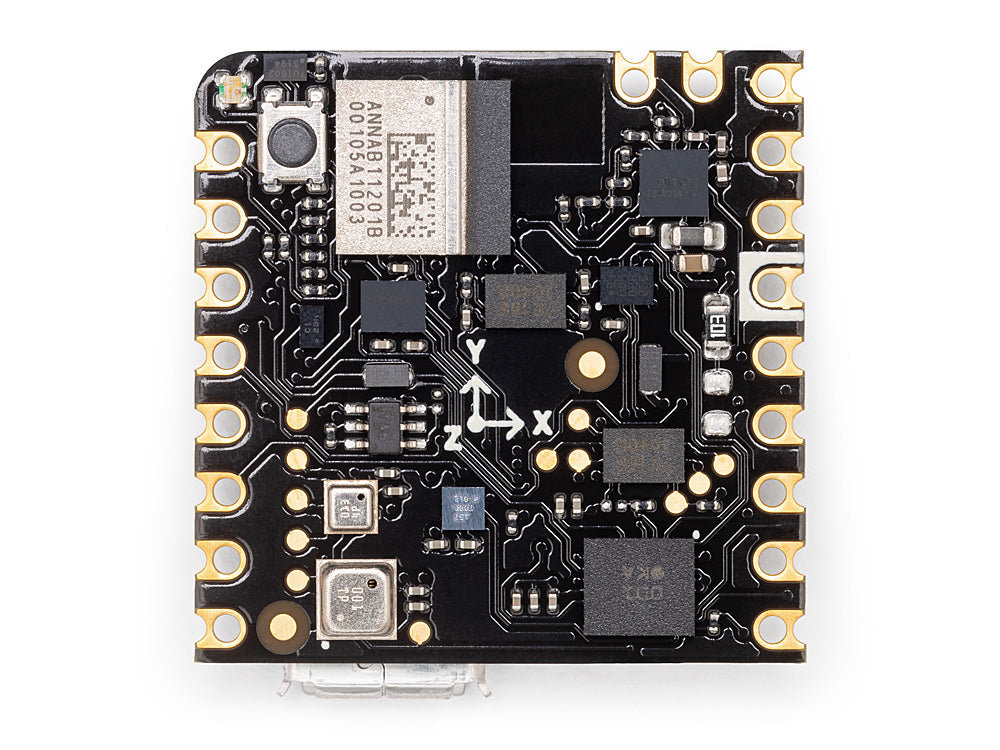
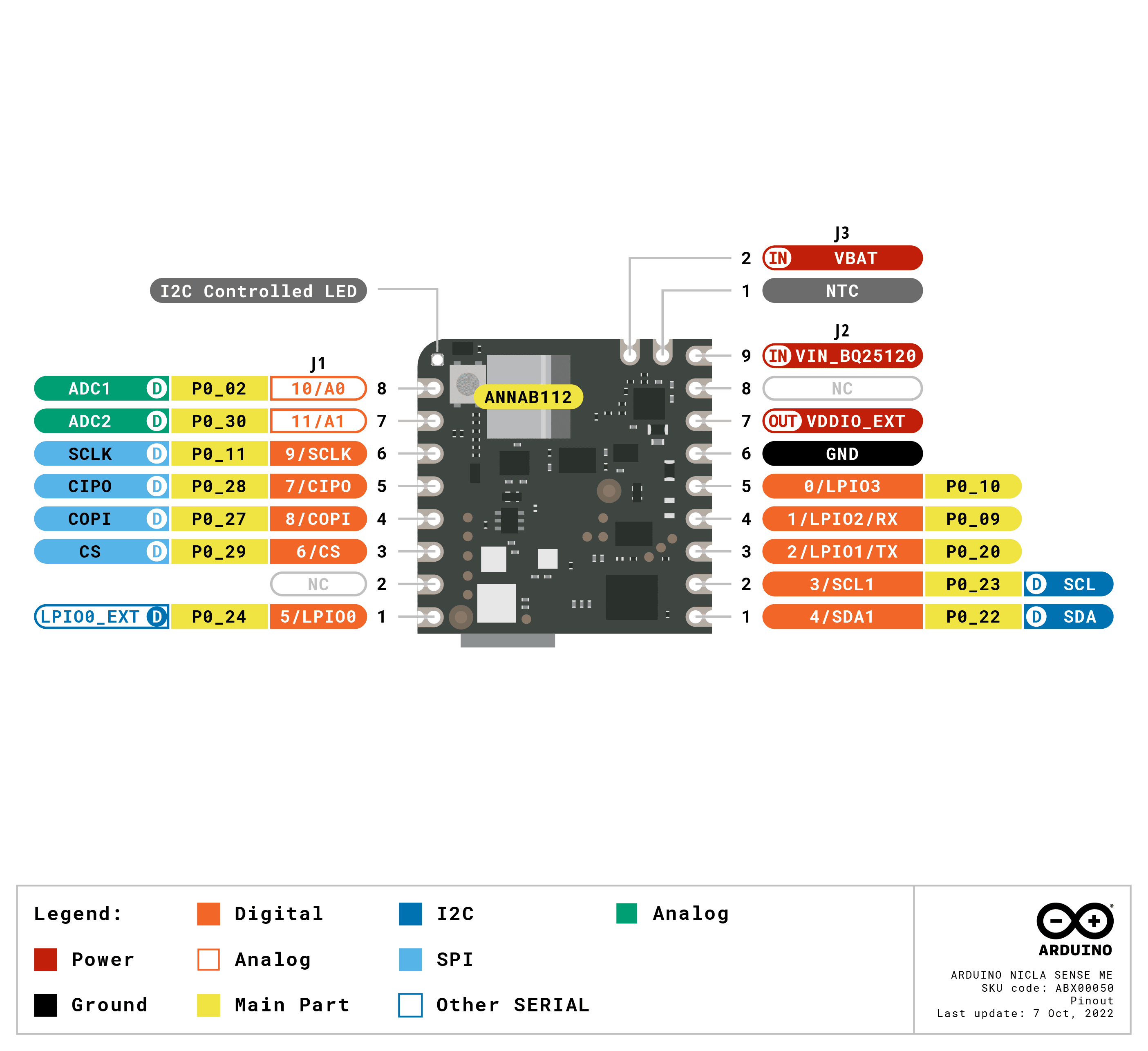
Pinout diagram
| Attr | Specs | verified |
|---|---|---|
main_mcu | Nordic Semiconductor nRF52832 — Arm Cortex-M4F (FPU) at 64 MHz, 512 KB internal flash (shared with the bootloader), 64 KB SRAM (store tech specs, datasheet "Microcontroller", tech-specs.yml). The core compiles it with -DARDUINO_ARCH_NRF52832, cortex-m4, upload.maximum_size=527616, upload.maximum_data_size=64288 (ArduinoCore-mbed boards.txt). | ✔ |
the_nrf52832_is_soldered_as_a_module | it sits inside the u-blox ANNA-B112 Bluetooth module — "Based on nRF52832 from Nordic Semiconductor, allowing you to run your own code (open CPU)", SiP 6.5 × 6.5 × 1.2 mm, Bluetooth 5.0 + Bluetooth Mesh, LE TX +5 dBm EIRP, up to 160 m range, 25 GPIO, 12-bit ADC, supply 1.7–3.6 V, −40…+85 °C (u-blox ANNA-B112 page). On the Nicla the module runs on a 1.8 V rail (datasheet). - Spec conflict: the store tech-spec table says "Bluetooth® 4.2" (store page) while Arduino's own tech-specs file and u-blox say Bluetooth 5.0 (tech-specs.yml, u-blox). The module's silicon (nRF52832) is a Bluetooth 5-capable part; treat "4.2" on the store page as stale. | ✔ |
no_gpu | (microcontroller board). | ? unverified |
radios | Bluetooth Low Energy only (2400–2483.5 MHz, internal antenna, internal 32 MHz oscillator + external SIT1532AI 32.768 kHz MEMS oscillator); no Wi-Fi, no cellular, no LoRa (datasheet board topology, user manual: "The Nicla Sense ME does not have built-in Wi-Fi"). | ✔ |
memory | 512 KB flash / 64 KB RAM (nRF52832) + 2 MB SPI flash (U7, MX25R1635FZUIH0) for data logging, hosted by the ANNA-B112 over SPI + 2 MB QSPI flash (U2, MX25R1635FZUIH0) dedicated to the BHI260AP for execute-in-place code and BSX fusion calibration data (datasheet, store tech specs). | ✔ |
sensors_all_bosch_sensortec_per_the_datasheet_s_functional_blocks | - BHI260AP (U5): smart sensor hub with Fuser2, 32-bit Synopsys DesignWare ARC EM4 CPU, integrated 16-bit 6-axis IMU (3-axis accelerometer + 3-axis gyroscope), self-learning AI, pedestrian dead reckoning, swim analytics, orientation; hosts the other sensors and runs the BSX 9-axis sensor-fusion firmware (datasheet, BHI260AP datasheet PDF, cheat sheet — BSX section). - BMP390 (U3): 24-bit absolute barometer, 300–1250 hPa, ±0.5 hPa absolute / ±0.03 hPa relative accuracy, 0.02 Pa RMS noise, 512-byte FIFO, up to 200 Hz; on the BHI260's SPI bus with the BME688 (datasheet, BMP390 datasheet PDF). - BMM150 (U4): 12-bit 3-axis geomagnetic sensor, ±1300 µT (X,Y) / ±2500 µT (Z), 0.3 µT resolution, <1 % FS non-linearity; on a dedicated I²C bus to the BHI260AP (datasheet, BMM150 datasheet PDF). - BME688 (U6): digital low-power gas (eNose, metal-oxide array, typical scan cycle 10.8 s) + integrated high-accuracy pressure (300–1100 hPa), humidity (0–100 %) and temperature (−40…+85 °C) sensing with AI; detects TVOCs, volatile sulfur compounds, CO and H₂ in the ppb range, outputs IAQ, bVOC- and CO₂-equivalents (datasheet, tech-specs.yml, Bosch BME688 product page, BME688 datasheet PDF). | ✔ |
usb_debug_bridge | the nRF52832 has no USB peripheral; a separate Microchip ATSAMD11D14A-MUT (U1) on the back acts as USB-to-serial bridge and JTAG/SWD controller for the ANNA-B112 (datasheet "USB Bridge"). USB connector: Micro-USB (tech-specs.yml); enumeration VID:PID 0x2341:0x0060 (ArduinoCore-mbed boards.txt). | ✔ |
other_ics | TI BQ25120AYFPR battery charger/PMIC (U9), Diodes AP2112K-3.3 0.6 A LDO (U14, powers the SAMD11 side), IS31FL3194 3-channel I²C LED driver (U8, up to 40 mA, 5 V boost) driving the SMLP34RGB2W3 RGB LED, level translators TXB0108 / NTS0304EUK ×2 / SN74LVC1T45 (datasheet board topology). | ✔ |
gpio_castellated_2_8_9_pad_headers_mkr_shield_compatible | 10 digital I/O (Arduino pins 0–9; A0/A1 also usable as digital → the user manual counts "twelve digital pins" including them), 2 analog inputs A0 = P0_02, A1 = P0_30, 12 PWM-capable pins, ADC configurable 8/10/12 bits (nRF52832 ADC 12-bit/200 ksps), 1 exposed SPI (CS/COPI/CIPO/SCLK), 1 exposed I²C (SDA1/SCL1), 1 UART (Rx = GPIO2, Tx = GPIO1), 4 LPIO lines (tech-specs.yml, user manual pin tables, datasheet J1/J2 pinouts, full pinout PDF). - Logic level: board core runs at 1.8 V; external I/O level is set by VDDIO_EXT, software-programmable 1.8–3.3 V (default 3.3 V translation on external pins). ADC reference is fixed at 1.8 V — inputs tolerate 3.3 V but readings saturate above 1.8 V (datasheet ratings, user manual ADC section). - Low-power I/O: "digital I/O's are low power, so to drive output devices like LEDs, resistive loads, buzzers, etc, it is recommended to use a MOSFET driver or a buffer" (user manual). - SWD test fins: J2 edge pads expose BHI260 / ANNA-B112 / SAMD11 SWD lines (1.8 V except SAMD11 at 3.3 V), RESET and the +1V8 rail (datasheet "J2 Fins"). | ✔ |
power | micro-USB (4.8–5.5 V), VIN 3.5–5.5 V (typ 5 V), ESLOV 5 V rail, or a 3.7 V single-cell LiPo/Li-ion on the 3-pin 1.2 mm ACH connector (J4, BM03B-ACHSS; mating ACHR-03V-S) with optional NTC thermistor line; recommended minimum battery capacity 200 mAh; Schottky reverse-polarity protection; BQ25120 hardware default charge current 40 mA (termination 4 mA), software-configurable via nicla::enableCharging(mA) (default 20 mA when called blank) (datasheet power tree, user manual "Powering the Board" / "Battery Charging"). | ✔ |
consumption_board_level_datasheet_table | standby 460 µA typ; blink sketch 960 µA typ; BLE advertising + sensor polling at 1 Hz 2.5 mA typ; advertising + polling once/hour 1.15 mA typ (measured with temperature + accelerometer + gyroscope enabled at 1 Hz / 1 ms latency) (datasheet "Power Consumption"). Sensor-level: BMP390 < 3.2 µA at 1 Hz; BME688 2.1–3.7 µA at 1 Hz T/H/P, 90 µA ULP air-quality mode, 3.9 mA during a gas scan (datasheet, Bosch BME688 page). | ✔ |
operating_temperature | −40 … +85 °C (recommended operating conditions; matches the ANNA-B112 module range) (datasheet ratings, u-blox). | ✔ |
mechanical | 22.86 × 22.86 mm, 2 g (store tech specs, tech-specs.yml). | ✔ |
certifications | CE, FCC, UKCA, REACH, WEEE declared on the store page (store); the docs repository additionally hosts ISED, MIC, NCC, RoHS, SRRC certificates and CE/UKCA DoCs for ABX00050 (docs-content certifications folder, datasheet certifications section). | ✔ |
- Manufacturer: Arduino S.r.l., Via Andrea Appiani 25, Monza (MB), IT 20900 — manufacturer block on the official store page (store.arduino.cc/products/nicla-sense-me). It is an Arduino Pro product: "Part of Arduino Pro's new Nicla family of modular, intelligent products" (store page, arduino.cc/pro).
- SKU / product code: ABX00050 (datasheet identifier and docs metadata sku: [ABX00050], productCode: ['043'] — official datasheet, docs-content source product.md).
- Year: 2020 — Arduino's dedicated firmware/tools repository arduino/nicla-sense-me-fw was created 2020-11-12 (GitHub API created_at), and the official datasheet's revision history lists "first release" as rev 1 on 2021-05-27 (datasheet). The first Wayback snapshot of the store page is 2021-09-24 (web.archive.org CDX).
- Status: Active listing, in stock on 2026-10-13 — the store page is live with a working quantity selector and "available":true in its embedded product JSON (store page); software support is current: the "Arduino Mbed OS Nicla Boards" core is at v4.6.0, released 2026-05-28 (package_index.json, ArduinoCore-mbed releases).
- Price: €55.30 (VAT included) as listed on 2026-10-13 (store page).
- Variants / family: a single SKU (ABX00050); the store sells it with an ESLOV cable included per the datasheet's "Related Products / Accessories" section (datasheet). It is the sensing member of the Nicla family (siblings documented by Arduino include Nicla Vision; the forum has a dedicated "Nicla Family" category — forum.arduino.cc/c/hardware/nicla-family/nicla-family/170). There is no official successor board; the closest successor concept in Arduino's line-up is the Portenta-family sensing stack (Nicla Sense ME is documented as a companion to Portenta H7/C33 — user manual).
- ⚠ Sensor-set correction (frequently mis-quoted): this board does not carry a BMI088. The verified Bosch set is BHI260AP (AI sensor hub with integrated 16-bit 6-axis IMU), BMM150 (3-axis magnetometer), BMP390 (pressure) and BME688 (gas/environmental) — docs hardware page, store tech specs, datasheet.
+ Strengths
- Industrial 9-axis fusion + on-chip AI in 23 × 23 mm: the BHI260AP runs Bosch's BSX sensor-fusion (gyro + accel + BMM150 mag → absolute orientation) and pre-trained activity models (still/walking/running/bicycle/vehicle/tilt, step counter, tilt detector, wrist-tilt, pickup/glance gestures — full sensor-ID table in the cheat sheet); datasheet lists "self-learning AI, swim analytics, pedestrian dead reckoning" as BHI260AP features (datasheet, BHI260AP datasheet).
- AI gas sensing (eNose): BME688 + BSEC outputs (IAQ, bVOC-eq, CO₂-eq, compensated T/RH/R) via the SensorBSEC class; the library even ships BSEC2GasScannerCollectData / BSEC2GasScannerClassify examples for training custom gas classifiers (cheat sheet SensorBSEC table, Arduino_BHY2 examples, Bosch BME688 page).
- Three integration modes out of the box: standalone sketch, BLE peripheral to any host running Arduino_BHY2Host (NICLA_VIA_BLE), or ESLOV / MKR-shield I²C slave (NICLA_VIA_ESLOV, NICLA_AS_SHIELD; device side NICLA_I2C, NICLA_BLE, NICLA_BLE_AND_I2C) (cheat sheet, MKR-shield tutorial).
- Sensor hub as I²C slave: as an ESLOV/shield slave it behaves like a smart sensor peripheral (documented host examples: MKR WiFi 1010, Portenta H7/C33); compatibility matrix lists Portenta H7, H7 Lite, Vision Shield, MKR WiFi 1010 and the Edge Control carrier (compatibility.yml, MKR-shield tutorial).
- WebBLE dashboard & CLI: bhy webserver serves a browser dashboard that pairs with the bare board over Web Bluetooth — configure/read any sensor ID without a host MCU (CLI-tool tutorial, Web-BLE dashboard tutorial).
- Fail-safe recovery sketch: the Fail_Safe_flasher example stores a binary in the QSPI flash with CRC check; pressing the reset button 3× runs the fail-safe image — protection against bricking a remote node (Arduino_BHY2 docs, nicla-sense-me-fw README).
- Software-defined power tree: BQ25120 charger fully controllable from sketches — nicla::enableCharging(mA), nicla::setBatteryNTCEnabled, nicla::configureChargingSafetyTimer, nicla::getCurrentBatteryVoltage, nicla::getBatteryVoltagePercentage, nicla::getOperatingStatus (user manual "Battery Charging").
- 2 MB on-board data flash: StandaloneFlashStorage example logs accel/gyro/temperature/gas/rotation as CSV on the board (Arduino_BHY2 examples).
- Target applications per Arduino Pro: warehouse & perishable-goods ripening monitoring, distributed industrial sensing, hazardous-gas detection, wireless-sensor-network reference design ("The Nicla form factor has been specifically developed at Arduino as a standard for wireless sensor networks") (datasheet "Application Examples").
- Debug-friendly: SWD fins for all three ICs (ANNA-B112, BHI260AP, SAMD11) on 1.27 mm header pads; OpenOCD/CMSIS-DAP debug config in the core (debug.tool=gdb, target/nrf52.cfg) (datasheet J2 fins, boards.txt).
− Weaknesses
- Store vs docs BLE-version conflict: store table says Bluetooth 4.2, Arduino's own tech-specs and u-blox say 5.0 — see SoC section (store vs tech-specs.yml, u-blox).
- No native USB / non-standard upload: the nRF52832 is flashed through the onboard SAMD11 CMSIS-DAP probe via OpenOCD, so classic Mbed drag-drop doesn't apply and a stuck SAMD11 bridge can make the board invisible; users report boards that "do not connect anymore with the PC and the IDE" (boards.txt, forum thread 1422909); bootloader re-flashing is a recurring forum topic (forum thread 1386449).
- Upload fails when the sketch path contains a space — "Sketch can't be Uploaded to the NiclaSense ME if a Space is in the Path" (ArduinoCore-mbed issue #1025).
- nicla::begin HardFault under PlatformIO — open issue with multiple reports (ArduinoCore-mbed issue #372).
- BQ25120A charger register bug: "VIN UVLO fault flag in BQ25120A register doesn't trigger correctly when read using I2C" (ArduinoCore-mbed issue #933).
- Host-side hangs on ESLOV/I²C: "Intermittent host hang due to incorrect handling of host reset control pin" in the BHY2 host stack (nicla-sense-me-fw issue #167); community reports of a Nicla Sense ME and MKR WAN 1310 "not talking to each other" over I²C (forum thread 1403610).
- Orientation/fusion sensor quirks: SENSOR_ID_DEVICE_ORI_WU (ID 70) initially reports 0.000 regardless of orientation (nicla-sense-me-fw #102); newly added sensor IDs print no values (#114); general orientation-value confusion (#53); BSX calibration questions on the forum (forum thread 1420169).
- BLE connectivity issues reported with ArduinoBLE on this board (forum thread 1117597).
- ESLOV auto-power-down gotcha: "If there is no ESLOV activity in the first minute after power up, the LDO is disabled and then also ESLOV is disabled" (low-power design) — work around with BHY2.setLDOTimeout(milliSeconds) (cheat sheet).
- ADC reference is 1.8 V even though inputs tolerate 3.3 V — signals above 1.8 V read as full-scale; and analogWrite PWM is fixed at 500 Hz unless you drive the nRF PWM peripheral directly (nrfx example in the manual) (user manual).
- No SPI slave in the core (limits "use as plain sensor" designs; open feature request) (ArduinoCore-mbed #873); third-party SPI displays misbehave (#562).
- Zephyr-core port is rough: a forum deep-dive documents BHI260AP SPI reads returning all-zeros on the Zephyr target due to a missing devicetree binding (forum thread 1461890).
- Library repos are mirrors: file issues in arduino/nicla-sense-me-fw, not in the arduino-libraries mirrors (Arduino_BHY2 repo description).
- Low-power guidance is thin: the datasheet gives four consumption points but there is no documented deep-sleep API; users ask "LowPower mode?" on the forum (forum thread 1417944).
- Retour d'expérience expert expert — expert-arduino
- Bonjour a tous. J'ai passe pas mal de temps sur la Nicla Sense ME (ABX00050) et je voulais clarifier un point frequent : elle n'a pas de BMI088. Le set est bien BHI260AP, BMM150, BMP390 et BME688. Attention aussi au conflit de doc, le site parle de BLE 4.2 mais c'est bien du 5.0 via l'ANNA-B112. C'… — expert-arduino
- Merci pour ce retour, ca confirme mes doutes. J'ai justement eu la carte invisible via USB après une coupure de courant. J'ai du reflasher le bootloader en suivant un vieux tuto, mais c'est loin d'être intuitif. Concernant la partie capteurs, j'utilise le mode I2C esclave avec un Portenta, mais j'a… — maker-sensor
- Oui, le timeout du LDO est un piege classique, il faut bien utiliser BHY2.setLDOTimeout si tu veux garder l'ESLOV actif. Pour ma part, je galere avec la calibration de la fusion BSX. Le capteur d'orientation (ID 70) renvoie souvent 0.000 au démarrage et met du temps a se stabiliser. C'est frustrant… — algo-piou
Community feedback and projects
- Other Programming Options for Nicla Sense ME forum.arduino.cc
- Opta Wifi Nicla Sense Me over BLE? forum.arduino.cc
- Build CO2-probe/sensor with Nicla Sense ME- but how? forum.arduino.cc
- Portenta C33 with Nicla Sense ME forum.arduino.cc
- STEP other
- STL other
- BME688 datasheet
- BHI260AP datasheet
- PDF hoja de datos ABX00050 datasheet
- PDF de pinout completo pdf
- BMP390 datasheet
- PDF de esquemáticos schematic
- BMM150 datasheet
- hardware page
- store page (€55.30, tech specs, DoC list)
- docs-content source folder (all tutorial markdown, CAD, certs)
- ABX00050 datasheet PDF
- schematics PDF
- full pinout PDF
- STEP
- STL
- BHI260AP
- BMP390
- BMM150
- BME688
- product page
- u-blox ANNA-B112 module
- Bosch BSX sensor fusion
- ArduinoCore-mbed
- boards.txt
- releases
- arduino/nicla-sense-me-fw
- Arduino_BHY2 mirror
- docs
- Arduino_BHY2Host mirror
- ArduinoBLE
- ArduinoCore-zephyr
- Arduino forum — Nicla Sense ME category
- Arduino Help Center — Nicla Family
- Project Hub part search
- BHY2-Sensor-API (Bosch)
- Store vs docs BLE-version conflict: store table says Bluetooth 4.2, Arduino's own tech-specs and u-blox say 5.0 — see SoC section (store vs tech-specs.yml, u-blox).
- No native USB / non-standard upload: the nRF52832 is flashed through the onboard SAMD11 CMSIS-DAP probe via OpenOCD, so classic Mbed drag-drop doesn't apply and a stuck SAMD11 bridge can make the board invisible; users report boards that "do not connect anymore with the PC and the IDE" (boards.txt, forum thread 1422909); bootloader re-flashing is a recurring forum topic (forum thread 1386449).
- Upload fails when the sketch path contains a space — "Sketch can't be Uploaded to the NiclaSense ME if a Space is in the Path" (ArduinoCore-mbed issue #1025).
- nicla::begin HardFault under PlatformIO — open issue with multiple reports (ArduinoCore-mbed issue #372).
- BQ25120A charger register bug: "VIN UVLO fault flag in BQ25120A register doesn't trigger correctly when read using I2C" (ArduinoCore-mbed issue #933).
- Host-side hangs on ESLOV/I²C: "Intermittent host hang due to incorrect handling of host reset control pin" in the BHY2 host stack (nicla-sense-me-fw issue #167); community reports of a Nicla Sense ME and MKR WAN 1310 "not talking to each other" over I²C (forum thread 1403610).
- Orientation/fusion sensor quirks: SENSOR_ID_DEVICE_ORI_WU (ID 70) initially reports 0.000 regardless of orientation (nicla-sense-me-fw #102); newly added sensor IDs print no values (#114); general orientation-value confusion (#53); BSX calibration questions on the forum (forum thread 1420169).
- BLE connectivity issues reported with ArduinoBLE on this board (forum thread 1117597).
- ESLOV auto-power-down gotcha: "If there is no ESLOV activity in the first minute after power up, the LDO is disabled and then also ESLOV is disabled" (low-power design) — work around with BHY2.setLDOTimeout(milliSeconds) (cheat sheet).
- ADC reference is 1.8 V even though inputs tolerate 3.3 V — signals above 1.8 V read as full-scale; and analogWrite PWM is fixed at 500 Hz unless you drive the nRF PWM peripheral directly (nrfx example in the manual) (user manual).
- No SPI slave in the core (limits "use as plain sensor" designs; open feature request) (ArduinoCore-mbed #873); third-party SPI displays misbehave (#562).
- Zephyr-core port is rough: a forum deep-dive documents BHI260AP SPI reads returning all-zeros on the Zephyr target due to a missing devicetree binding (forum thread 1461890).
- Library repos are mirrors: file issues in arduino/nicla-sense-me-fw, not in the arduino-libraries mirrors (Arduino_BHY2 repo description).
- Low-power guidance is thin: the datasheet gives four consumption points but there is no documented deep-sleep API; users ask "LowPower mode?" on the forum (forum thread 1417944).
- Faire clignoter la LED RGB embarquée debutant Schéma : IMG-nicla-sense-me-debutant-1-niclasense-clignotement-led.svg — Nicla Sense ME vu de dessus, LED RGB SMLP34RGB2W3 entourée, câble micro-USB vers l'ordinateur, puce pilote IS31FL3194 indiquée sous la LED
- Bouton externe et console série interactive debutant Schéma : IMG-nicla-sense-me-debutant-2-niclasense-bouton-console.svg — Nicla Sense ME avec un bouton poussoir externe câblé entre la broche numérique 4 et la masse, résistance de pull-up interne symbolisée, câble USB vers l'ordinateur affichant la console
- Lire température et gaz avec le BME688 debutant Schéma : IMG-nicla-sense-me-debutant-3-niclasense-lecture-bme688.svg — Nicla Sense ME en gros plan avec les puces BME688 et BHI260AP mises en évidence et flèches vers un petit graphique température/gaz affiché sur l'ordinateur en série
- Acquitter un microphone PDM externe intermediaire Schéma : IMG-nicla-sense-me-intermediaire-1-niclasense-micro-pdm.svg — Petit microphone MEMS au format boîtier avec deux fils horloge et données rejoignant les broches numériques du Nicla Sense ME, onde sonore stylisée au-dessus du micro
- Diffuser ses capteurs en BLE avec ArduinoBLE intermediaire Schéma : IMG-nicla-sense-me-intermediaire-2-niclasense-ble-arduino.svg — Nicla Sense ME au centre émettant des ondes BLE vers un smartphone affichant une carte de caractéristique température, module ANNA-B112 et puce nRF52832 annotés sous la carte
- Connecter le Nicla au WiFi via une carte hôte intermediaire Schéma : IMG-nicla-sense-me-intermediaire-3-niclasense-wifi-via-passerelle.svg — Nicla Sense ME relié par liaison BLE ou câble ESLOV à un MKR WiFi 1010, lui-même relié par un arc WiFi à une borne Internet, nuage et routeur annotés
- Sommeil basse consommation et réveil sur interruption avance Schéma : IMG-nicla-sense-me-avance-1-niclasense-sommeil-bas-courant.svg — Nicla Sense ME sur batterie LiPo avec microampèremètre en série sur l'alimentation, croissant de lune au-dessus de la carte et flèche de réveil vers la broche d'interruption
- Enregistreur de capteurs sur la flash embarquée avance Schéma : IMG-nicla-sense-me-avance-2-niclasense-enregistreur-flash.svg — Nicla Sense ME avec puce de flash SPI 2 MB mise en évidence, flèches entrantes des capteurs et sortantes d'un fichier CSV vers l'ordinateur, carte SD barrée pour signifier l'absence de slot
- Publier capteurs et batterie en MQTT via une passerelle avance Schéma : IMG-nicla-sense-me-avance-3-niclasense-mqtt-batterie.svg — Chaîne complète : Nicla Sense ME sur batterie publiant en BLE, MKR WiFi 1010 en passerelle, flux MQTT pointillé vers un courtier sur un serveur, jauge de batterie affichée sur un téléphone
Code library — examples written for this board
led_rgb.inoArduinoimu_bhi260.inoArduinorotation_fusion.inoArduinopression_bmp390.inoArduinonose_electronique.inoArduinoboussole_bmm150.inoArduinoble_stream.inoArduinodetection_chute.inoArduinobatterie_lipo.inoArduinologging_csv_usb.inoArduino
Examples and repos found online
- arduino-libraries/Arduino_NiclaSenseEnv github.com
- arduino/ArduinoCore-samd github.com