M5Stamp Timer Power 2 (PY32L020)
⚡ The essentials in 60 seconds
- soc — PY32L020
- power_ic — M5PM1
- charging_ic — LGS4056HDA
- communication — I2C @ 0x6E (100 kHz / 400 kHz)
- io — 5x programmable IO (GPIO/ADC/PWM/RGB LED/IRQ)
- power_input — DC 5V / DC 3.7V lithium battery
- On this board : 9 tutorials · 6 code
In the intricate world of embedded systems, where every microampere counts and every square millimeter of board space is precious, the challenge of power management often dictates the success or failure of a project. The M5Stamp Timer Power 2, identified by SKU S021, emerges as a sophisticated solution to this persistent engineering dilemma, offering a compact, highly efficient module designed specifically for battery-powered devices that demand extended operational lifetimes. At its core, this module is not merely a passive component but an intelligent power manager built around the PY32L020 microcontroller. This choice of central processing unit is significant because it allows the module to actively monitor, control, and optimize energy flow rather than simply regulating voltage. By integrating a dedicated microcontroller, the M5Stamp Timer Power 2 can execute complex power strategies, such as scheduled wake-ups and dynamic load balancing, which are essential for applications like remote sensors, wearable technology, and Internet of Things nodes that must operate for months or even years on a single charge.
The heart of the module’s efficiency lies in its specialized power management architecture, which combines the M5PM1 power management integrated circuit with the LGS4056HDA charging circuit. This dual-chip approach allows for a multi-stage energy management system that significantly reduces standby consumption, a critical factor in low-power design. When a device is idle, it does not need to draw significant current; however, traditional linear regulators often leak power, draining batteries slowly but surely. The M5PM1 addresses this by enabling ultra-low power states. Specifically, the module achieves a shutdown current of just 6.72 microamperes and a sleep current of 12.27 microamperes when operating at 4.2 volts. To put these figures into perspective, one microampere is one millionth of an ampere; such minuscule consumption means that a standard lithium battery can sustain the module in a dormant state for an exceptionally long period, preserving energy for when the device actually needs to perform its primary function. This level of efficiency is achieved through careful hardware design and firmware control, allowing the system to enter deep sleep modes where non-essential circuits are completely powered down.
Power input flexibility is another cornerstone of the M5Stamp Timer Power 2’s design philosophy. The module is engineered to accept two primary sources of energy: a standard DC 5V supply, typically from a USB connection or an external adapter, or a 3.7V lithium battery. This dual-input capability makes it versatile for both development and deployment phases. During development, engineers can use a stable 5V source for debugging and testing, while in the final product, the system can seamlessly switch to battery power. The charging process is handled by the LGS4056HDA circuit, which offers adjustable charging currents of either 650 milliamperes or 180 milliamperes. This adjustability is a subtle but powerful feature. A higher current of 650mA allows for rapid recharging, which is convenient during initial setup or when quick turnaround times are necessary. Conversely, the 180mA setting is ideal for delicate battery care or when the power source is limited, such as when charging from a low-current USB port or a solar panel. This flexibility ensures that the battery’s lifespan is maximized by avoiding unnecessary stress from high-current charging when it is not required.
Communication and control are facilitated through the Inter-Integrated Circuit (I2C) bus, a widely used serial communication protocol in embedded systems. The module operates at the I2C address 0x6E and supports standard speeds of 100 kHz and fast speeds of 400 kHz. This interface allows the host microcontroller to configure the power management settings, read status registers, and control the various output rails. By using I2C, the M5Stamp Timer Power 2 integrates easily into existing systems without requiring a large number of input/output pins, freeing up valuable GPIOs on the main controller for other tasks. This simplicity of integration is crucial for developers who need to add advanced power management capabilities to a project without redesigning the entire circuit board. The digital nature of the I2C interface also allows for precise control over power states, enabling software-driven decisions on when to power up peripherals, when to enter sleep mode, and how to handle wake-up events.
The module provides five programmable Input/Output pins, which offer remarkable versatility for interfacing with external components. These pins can be configured as General Purpose Input/Output (GPIO) for digital signals, Analog-to-Digital Converter (ADC) inputs for reading sensor data, Pulse Width Modulation (PWM) outputs for controlling motors or LEDs, or as interrupt request (IRQ) lines for handling asynchronous events. Additionally, they can drive an RGB LED, providing visual feedback on the system’s status. This multi-functionality means that a single set of pins can serve multiple purposes depending on the application’s needs. For instance, one pin could be used to read a battery voltage sensor via the ADC, while another could trigger an interrupt when a button is pressed, waking the system from sleep. The ability to configure these pins dynamically allows for a high degree of customization, making the module suitable for a wide range of applications from simple data loggers to complex interactive devices.
Power delivery to the rest of the system is managed through several distinct output rails, each optimized for different types of loads. The 3V3_DCDC_OUT rail provides up to 0.6 amperes using a DC-DC converter, which is efficient for powering digital logic and microcontrollers. The 3V3_LDO_OUT rail offers up to 0.4 amperes using a Low Dropout Regulator, which is ideal for analog components or sensitive circuits that require a very clean, noise-free power supply. Another 3.3V rail, PY_3V3, also supplies up to 0.4 amperes, likely dedicated to the internal microcontroller or specific subsystems. Finally, the EXT_5V_INOUT rail can provide up to 1 ampere, allowing the module to boost the battery voltage to 5V for components that require higher voltage, such as certain sensors or communication modules. This segmented approach to power distribution ensures that each part of the system receives the appropriate voltage and current, optimizing overall efficiency and performance.
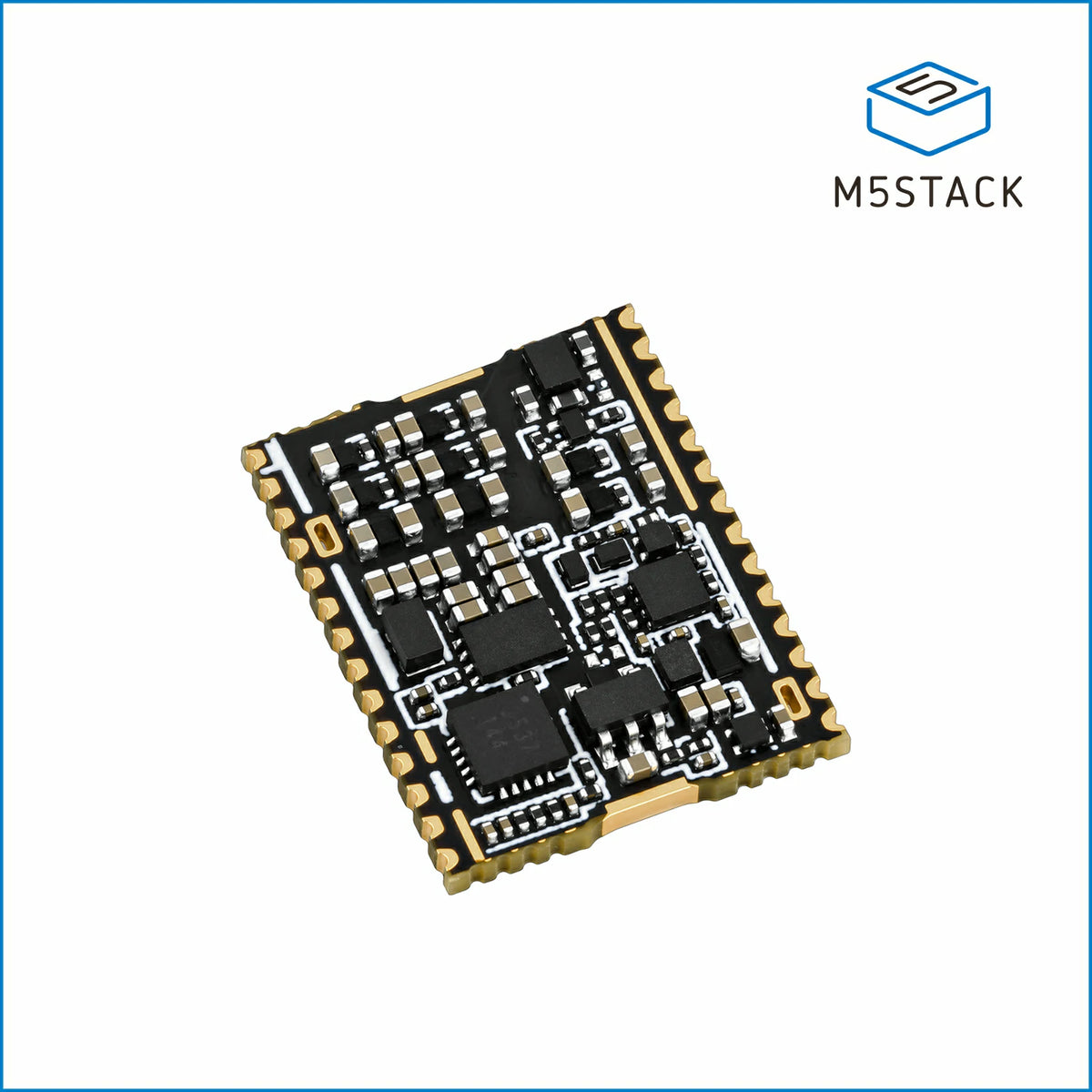
Physically, the M5Stamp Timer Power 2 is designed for space-constrained applications. It comes in a compact castellated-hole package with 28 pins spaced at 1.27 millimeters. Castellated holes are a clever packaging technique where the edges of the printed circuit board have half-hole pads, allowing the module to be soldered directly onto a carrier board. This method saves space compared to traditional connectors and provides a robust mechanical and electrical connection. The module’s dimensions are 18.0 x 14.0 x 2.2 millimeters, and it weighs only 0.7 grams. This small footprint and light weight make it an excellent choice for wearable devices, drones, and other portable electronics where size and weight are critical constraints. The low profile of 2.2 millimeters also allows it to fit into slim enclosures, further expanding its potential applications.
The module also supports scheduled wake-ups and external interrupt wake-ups, which are essential for autonomous operation. Scheduled wake-ups allow the system to periodically wake up, perform a task such as reading a sensor or transmitting data, and then return to sleep. This is typical for environmental monitoring applications where data is collected at regular intervals. External interrupt wake-ups allow the system to remain in a deep sleep state until a specific event occurs, such as a door opening, a button press, or a threshold being crossed by a sensor. This event-driven approach minimizes power consumption by ensuring that the system is only active when necessary. Together, these features make the M5Stamp Timer Power 2 a powerful tool for engineers seeking to maximize battery life without compromising on functionality or responsiveness.
| Attr | Specs | verified |
|---|---|---|
soc | PY32L020 | ? unverified |
power_ic | M5PM1 | ? unverified |
charging_ic | LGS4056HDA | ? unverified |
communication | I2C @ 0x6E (100 kHz / 400 kHz) | ? unverified |
io | 5x programmable IO (GPIO/ADC/PWM/RGB LED/IRQ) | ? unverified |
power_input | DC 5V / DC 3.7V lithium battery | ? unverified |
charging_current | Adjustable 650mA / 180mA | ? unverified |
power_consumption_shutdown | 6.72uA @ DC 4.2V | ? unverified |
power_consumption_sleep | 12.27uA @ DC 4.2V | ? unverified |
load_capacity_3v3_dcdc | 0.6A | ? unverified |
load_capacity_5v | 1A | ? unverified |
package | 1.27mm-28Pin castellated-hole | ? unverified |
dimensions | 18.0 x 14.0 x 2.2 mm | ? unverified |
weight | 0.7 g | ? unverified |
sku | S021 | ? unverified |
Power management module designed for low-power embedded devices. It integrates the PY32L020 microcontroller, M5PM1 power management chip, and LGS4056HDA charging circuit to optimize energy usage.
+ Strengths
["- Ultra-low power consumption: 6.72uA in shutdown mode and 12.27uA in standby at 4.2V","- Multi-stage power management with adjustable charging currents (650mA or 180mA)","- Compact form factor (18.0 x 14.0 x 2.2 mm, 0.7g) with 28-pin castellated-hole package"]
− Weaknesses
["- Limited output capacity: 0.6A on 3V3_DCDC_OUT and 0.4A on LDO outputs","- Single communication interface via I2C (address 0x6E)","- Restricted I/O count with only 5 programmable IOs"]
- Retour d'expérience expert expert — expert-microdb
- Après intégration, le S021 est bluffant. Le sommeil profond à 6.72uA change tout pour nos capteurs. L'interface I2C (0x6E) est stable, mais attention à la gestion des 3 rails de sortie : ne surchargez pas le LDO (0.4A max). La taille castellated est idéale pour le prototypage rapide. Un vrai gain d… — expert-microdb
- Bon retour ! J'ai galéré avec le réveil par interruption. Pensez à bien configurer les GPIO avant le mode arrêt. Le courant de charge ajustable (180/650mA) est pratique pour protéger les petites batteries LiPo. Le format 18x14mm permet de le cacher facilement dans un boîtier compact. — membre-forum
Community feedback and projects
- Discussions Reddit — M5Stamp Timer Power 2 (PY32L020) reddit.com
- Articles CNX Software — M5Stamp Timer Power 2 (PY32L020) cnx-software.com
Content not available yet.
Content not available yet.
Content not available yet.
["- not specified"]
- First Connection and Startup of the M5Stamp Timer Power 2 debutant Apprenez à alimenter, connecter et vérifier le fonctionnement de base du module de gestion d'alimentation M5Stamp Timer Power 2.
- Controlling GPIOs with M5Stamp Timer Power 2 debutant Apprenez à configurer les broches d'entrée/sortie pour piloter une LED ou lire un bouton sur le module de gestion d'alimentation.
- Simple Automation with M5Stamp Timer Power 2 debutant Apprenez à configurer le réveil programmé pour contrôler un périphérique externe tout en minimisant la consommation d'énergie.
- M5Stamp Timer Power 2: First connection and startup intermediaire Guide pratique pour alimenter, configurer et vérifier le fonctionnement de base du module de gestion d'énergie M5Stamp Timer Power 2.
- Configure M5Stamp Timer Power 2 I/O intermediaire Apprenez à piloter les GPIO, PWM et ADC du module PY32L020 pour interagir avec des capteurs ou affichages.
- Home Automation with M5Stamp Timer Power 2 intermediaire Apprenez à configurer le M5Stamp Timer Power 2 pour contrôler des périphériques domotiques en mode veille ultra-basse consommation.
- M5Stamp Timer Power 2: Wiring and First Boot avance Guide avancé pour l'intégration, le câblage et la vérification initiale du module de gestion d'alimentation PY32L020.
- Advanced I/O Control and Power Management on M5Stamp Timer Power 2 avance Ce tutoriel explique comment configurer les 5 IO programmables pour l'acquisition de données et le contrôle de périphériques tout en minimisant la consommation grâce aux modes veille profonds du PY32L
- Energy-Aware Automation with M5Stamp Timer Power 2 avance Implémentez une logique de réveil programmé et de gestion dynamique des sorties pour optimiser l'autonomie d'un nœud IoT.