FriendlyElec CM3588 SOM (Rockchip RK3588)
⚡ The essentials in 60 seconds
- soc — Rockchip RK3588
- cpu — Quad-core ARM Cortex-A76 (up to 2.4GHz) and quad-core Cortex-A55 (up to 1.8GHz)
- gpu — Mali-G610 MP4
- npu — 6TOPs, supports INT4/INT8/INT16/FP16
- ram — 4GB/8GB/16GB LPDDR4X or 32GB LPDDR5
- storage — 0GB/64GB/256GB eMMC (optional), 1x microSD interface
- On this board : 8 tutorials · 10 code
Imagine a computing device that fits within the palm of your hand, smaller than a standard credit card, yet possesses the raw processing power to handle tasks that would have required a full-sized desktop computer just a few years ago. This is the essence of the CM3588, a high-performance System on Module developed by FriendlyElec. To understand its significance, one must first grasp the concept of a System on Module, or SOM. Unlike a traditional single-board computer where every component is soldered onto a large, fixed circuit board, a SOM is a compact, self-contained unit that integrates the most critical components of a computer—such as the processor, memory, and storage controllers—onto a single, small printed circuit board. This design philosophy allows engineers and hobbyists to embed powerful computing capabilities into custom designs without having to design complex high-speed circuits from scratch. The CM3588 serves as the brain of such systems, offering a balance of extreme performance and modular flexibility that is rare in the embedded world.
At the heart of this module lies the Rockchip RK3588, a sophisticated System on Chip that orchestrates all computational activities. The RK3588 employs a heterogeneous architecture, meaning it uses different types of processor cores to handle different kinds of tasks efficiently. Specifically, it features an octa-core CPU configuration, which is a fancy way of saying it has eight processing units. Four of these are ARM Cortex-A76 cores, which are high-performance cores capable of running at speeds up to 2.4 GHz. These cores are designed for demanding tasks that require quick, sequential processing, such as running operating system kernels or complex applications. The other four cores are ARM Cortex-A55, running at up to 1.8 GHz. These are efficiency cores, optimized for background tasks and lighter workloads, allowing the system to save power when full speed is not required. This big.LITTLE style architecture ensures that the module remains responsive during heavy loads while staying energy-efficient during idle periods.
Beyond the central processing unit, the CM3588 is equipped with a Mali-G610 MP4 Graphics Processing Unit. While many people associate GPUs solely with gaming, in the context of embedded systems, they are crucial for rendering user interfaces, decoding high-resolution video, and accelerating certain computational tasks. The MP4 designation indicates that this GPU has four shader cores, providing sufficient graphical horsepower for multi-display setups and smooth visual experiences. Perhaps the most forward-looking feature of the RK3588 is its Neural Processing Unit, or NPU. With a capability of 6 TOPS (trillions of operations per second), this dedicated hardware accelerator is designed specifically for artificial intelligence and machine learning tasks. It supports various data precisions, including INT4, INT8, INT16, and FP16, allowing developers to run complex neural networks for image recognition, natural language processing, or automated quality control directly on the device, without needing to send data to the cloud.
Memory and storage are the lifelines of any computer, and the CM3588 offers considerable flexibility here. The module is available with various RAM configurations, ranging from 4 GB to 16 GB of LPDDR4X memory, or even up to 32 GB of the faster LPDDR5 standard. LPDDR stands for Low Power Double Data Rate, indicating memory that is both fast and energy-efficient, which is vital for compact devices. For storage, the module offers optional embedded MultiMediaCard (eMMC) storage of 64 GB or 256 GB, which is soldered directly onto the board for reliability. Additionally, it provides a microSD interface, allowing users to expand storage or boot from removable media, offering a familiar and convenient way to manage data.
Connectivity is where the CM3588 truly shines, bridging the gap between embedded simplicity and desktop-class versatility. The module includes a 2.5 Gigabit Ethernet port, powered by the RTL8125B controller. This is significantly faster than the standard 1 Gigabit Ethernet found on many other single-board computers, making it ideal for network-attached storage (NAS) applications where large files need to be transferred quickly. The USB capabilities are equally robust, featuring two USB 3.1 Gen1 OTG ports, one USB 3.1 Gen1 Host port, and two USB 2.0 Host ports. The OTG (On-The-Go) capability is particularly interesting; it allows the module to act as either a host or a peripheral device, providing flexibility in how it connects to other hardware. For video, the CM3588 supports two HDMI 2.1 outputs, capable of driving displays at resolutions up to 8K at 60 Hz. It also includes an HDMI input, allowing it to capture video from external sources at up to 4K resolution, a feature that opens doors for video streaming, recording, and digital signage applications.
To integrate this module into custom projects, FriendlyElec has exposed its resources through four 100-pin connectors. These connectors provide access to 81 General Purpose Input/Output (GPIO) pins, which are the digital and analog interfaces used to connect sensors, buttons, LEDs, and other electronic components. Furthermore, the module supports up to four PCIe interfaces with configurable lanes. PCIe is the high-speed interface standard used for connecting solid-state drives, network cards, and other high-bandwidth peripherals. This extensive I/O capability means that the CM3588 can be paired with carrier boards that add specific functionalities, such as multiple NVMe SSD slots for high-speed storage arrays, making it a popular choice for DIY NAS kits that support up to four NVMe drives.
The physical footprint of the CM3588 is remarkably small, measuring 55x65x1.6 mm for the standard version and slightly larger at 55x67.5x1.6 mm for the Plus version. Despite its compact size, it draws power from a 5-20VDC input, with a maximum consumption of 20W. This wide voltage range provides flexibility in power supply design, accommodating various adapters and power sources. The module is supported by a wide range of operating systems, including Android, Ubuntu, Debian, Buildroot, OpenWrt, and OpenMediaVault. This software versatility ensures that whether you are building a media center, a home automation hub, a network router, or an AI edge device, there is a well-supported software environment ready to go. In summary, the CM3588 represents a convergence of high-end mobile computing technology and embedded flexibility, offering a powerful, compact, and highly connected foundation for the next generation of smart devices.
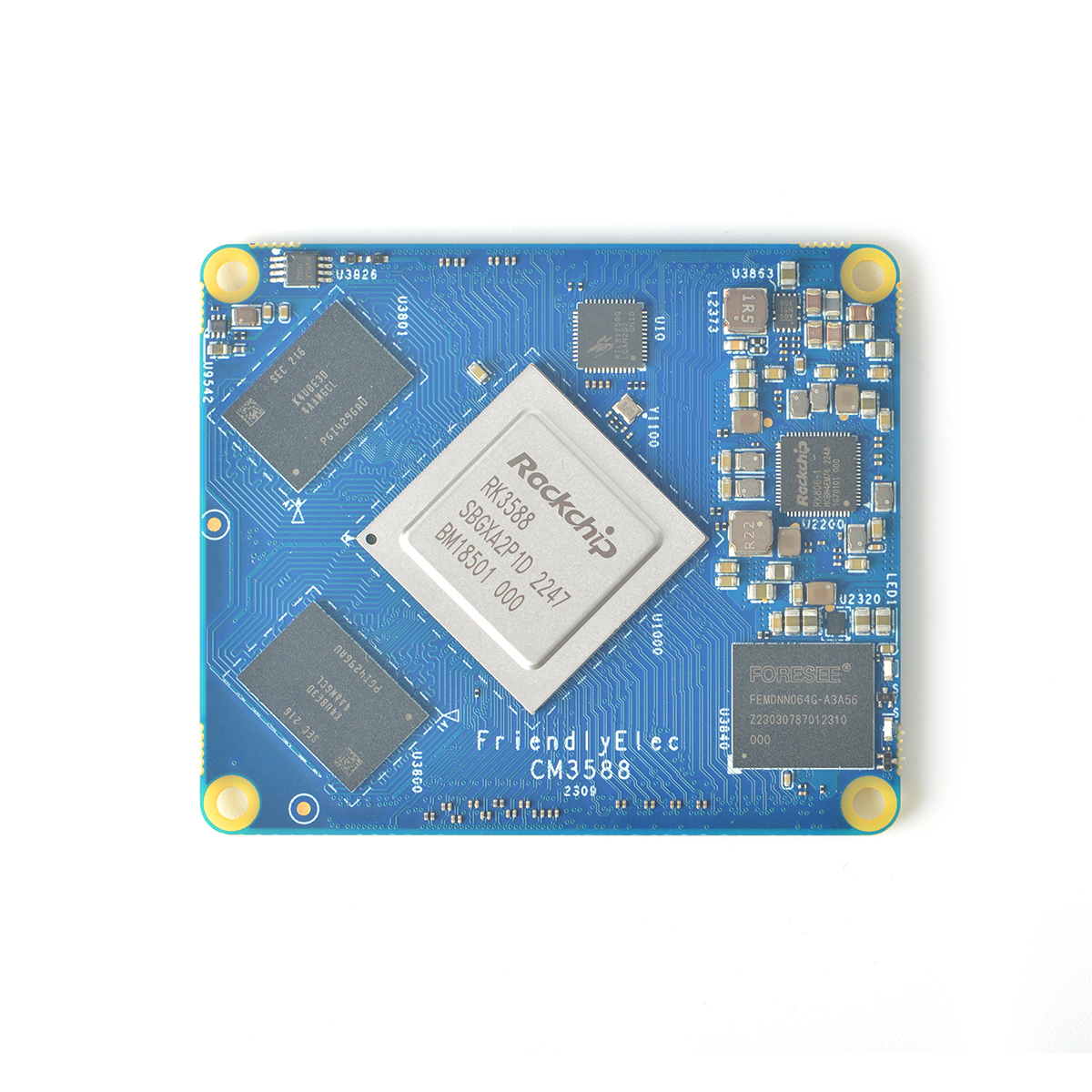
| Attr | Specs | verified |
|---|---|---|
soc | Rockchip RK3588 | ? unverified |
cpu | Quad-core ARM Cortex-A76 (up to 2.4GHz) and quad-core Cortex-A55 (up to 1.8GHz) | ? unverified |
gpu | Mali-G610 MP4 | ? unverified |
npu | 6TOPs, supports INT4/INT8/INT16/FP16 | ? unverified |
ram | 4GB/8GB/16GB LPDDR4X or 32GB LPDDR5 | ? unverified |
storage | 0GB/64GB/256GB eMMC (optional), 1x microSD interface | ? unverified |
ethernet | 1x On-board PCIe 2.5G ethernet controller (RTL8125B) | ? unverified |
video | 2x HDMI 2.1 outputs (up to 8K60p), 1x HDMI input (up to 4K60p) | ? unverified |
usb | 2x USB 3.1 Gen1 OTG, 1x USB 3.1 Gen1 Host, 2x USB 2.0 Host | ? unverified |
pcie | Up to 4x PCIe interfaces (configurable lanes) | ? unverified |
gpio | 81x GPIOs, 3x SPIs, 7x UARTs, 6x I2Cs, 15x PWMs, 3x I2Ss | ? unverified |
power | 5~20VDC input, 20W max | ? unverified |
dimensions | 55x65x1.6mm (CM3588) or 55x67.5x1.6mm (CM3588 Plus) | ? unverified |
os | Android, Ubuntu, Debian, Buildroot, OpenWrt, OpenMediaVault | ? unverified |
The CM3588 is a System-on-Module (SOM) developed by FriendlyElec, based on the Rockchip RK3588 SoC. Designed for high-performance applications, it targets NAS kits and projects requiring advanced video management and AI computing power.
+ Strengths
["- Octa-core CPU (4x Cortex-A76 @ 2.4 GHz, 4x Cortex-A55 @ 1.8 GHz) and 6 TOPS NPU","- 8K@60Hz video support via two HDMI 2.1 outputs and one HDMI 4K@60Hz input","- Rich connectivity with 2.5 GbE Ethernet, up to 4 PCIe interfaces, and 81 GPIOs"]
− Weaknesses
["- Maximum power consumption of 20W requiring a 5-20VDC power supply","- Optional eMMC storage (up to 256 GB) increasing cost or complexity","- Compact dimensions (55x65mm) requiring specific carrier board design"]
- Retour d'expérience expert expert — expert-microdb
- Après 3 mois sur un projet de vision industrielle, le CM3588 est une bête. La NPU de 6 TOPS gère nos modèles YOLO sans latence, et le RK3588 tient bien en thermique passif sous 20W. Le vrai atout ? La connectivité. Le port 2,5GbE (RTL8125B) est stable, crucial pour le transfert de flux 4K via l'ent… — expert-microdb
- Bon retour. J'ai testé la version Plus (32Go LPDDR5) pour du virtualisation ARM. La différence en mémoire est réelle sur les charges lourdes, mais chère. Le point noir reste l'alimentation : les 5-20V demandent une régulation propre, sinon instabilités USB. Pour le HDMI 2.1 8K, c'est surtout market… — membre-forum
Community feedback and projects
- Discussions Reddit — CM3588 reddit.com
- Articles CNX Software — CM3588 cnx-software.com
Content not available yet.
Content not available yet.
Content not available yet.
["- not specified"]
- CM3588: First Connection and Boot debutant Guide pas à pas pour assembler, alimenter et démarrer votre module CM3588 pour la première fois.
- Create a simple NAS with CM3588 debutant Apprenez à configurer un stockage réseau partagé sur votre CM3588 pour accéder à vos fichiers depuis tous vos appareils.
- First connection and booting of the CM3588 intermediaire Guide étape par étape pour installer le module CM3588 sur une carte de base et lancer son premier système d'exploitation.
- Interfacing GPIO and Peripherals on CM3588 intermediaire Apprenez à configurer et utiliser les 81 GPIO du module CM3588 pour connecter capteurs et afficheurs via les connecteurs 100 broches.
- Create an automated NAS with the CM3588 intermediaire Transformez votre CM3588 en un serveur NAS haute performance avec synchronisation automatique et accès distant sécurisé.
- CM3588: First Boot and Hardware Diagnostics avance Guide avancé pour initialiser le module CM3588, valider l'alimentation et diagnostiquer les interfaces critiques.
- Mastering I/O: GPIO, Sensors, and Displays on CM3588 avance Guide avancé pour configurer les GPIO, interfacer des capteurs via MIPI/I2C et piloter des affichages HDMI/MIPI sur le module CM3588.
- Deploy an Automated High-Performance NAS on CM3588 avance Configurez un serveur de fichiers robuste avec stockage RAID logiciel et synchronisation automatique pour exploiter la bande passante 2,5 GbE du CM3588.
Code library — examples written for this board
cm3588-gpio-led-blink.inoCcm3588-npu-inference.pyPythoncm3588-25gbe-throughput.shBashcm3588-nvme-raid.shBashcm3588-mipi-camera.inoCcm3588-nvme-raid-benchmark-6.inoBashcm3588-gpio-i2c-control-7.inoPythoncm3588-hw-watchdog-reset-8.inoCcm3588-neural-network-inference-9.inoPythoncm3588-4k-hdmi-output-10.inoBash