BIOSTAR EdgeComp MS-U320: Fanless Intel Wildcat Lake Industrial Mini PC
⚡ The essentials in 60 seconds
- soc — Intel Core 3 304 ou Core 5 320 (Wildcat Lake)
- ram — Jusqu'à 64GB DDR5-6400 (1x SO-DIMM)
- storage — M.2 Key M 2242/2280 NVMe SSD (PCIe Gen4 x2)
- wifi_bluetooth — Optionnel via M.2 Key-E 2230
- ethernet — 2x 2.5GbE RJ45 (Intel I226-V et I226-LM)
- video — HDMI 2.1 (4K@60Hz) et DisplayPort 1.4 (4K@60Hz)
- On this board : 9 tutorials · 10 code
The BIOSTAR EdgeComp MS-U320 represents a significant entry into the industrial computing landscape, arriving in November 2026 as a fanless mini PC designed to bridge the gap between high-performance consumer hardware and the rugged reliability required by industrial applications. At its core, this compact device leverages the Intel Wildcat Lake platform, offering users a choice between two distinct System-on-Chip configurations that cater to varying computational needs. The first option is the Intel Core 3 304, a five-core processor that includes a Neural Processing Unit capable of delivering 15 TOPS of AI performance. For those requiring slightly more headroom, the second option is the Intel Core 5 320, which steps up to six cores and provides 16 TOPS of NPU performance. Both processors are paired with Intel Xe3 graphics, ensuring that visual output remains smooth and capable of handling modern display requirements. This dual-processor approach allows integrators to select the precise balance of power and efficiency needed for their specific deployment, whether it involves light data processing or more demanding edge AI tasks.
Memory and storage capabilities are designed to be both robust and flexible, adhering to the latest standards while maintaining the compact form factor essential for industrial enclosures. The system supports up to 64GB of DDR5-6400 memory, installed via a single SO-DIMM slot. This configuration highlights a trade-off common in small-form-factor devices: while the maximum capacity is substantial for an industrial controller, the single-slot design means that upgrading memory later may require replacing the existing module rather than adding to it. For storage, the MS-U320 relies on an M.2 Key M slot that accepts NVMe SSDs in either 2242 or 2280 sizes, operating over PCIe Gen4 x2 lanes. This interface ensures rapid data access and boot times, which are critical for systems that must recover quickly from power cycles or handle large datasets locally. The use of NVMe technology over traditional SATA interfaces significantly reduces latency, making the device suitable for applications where real-time data logging or quick retrieval of operational logs is necessary.
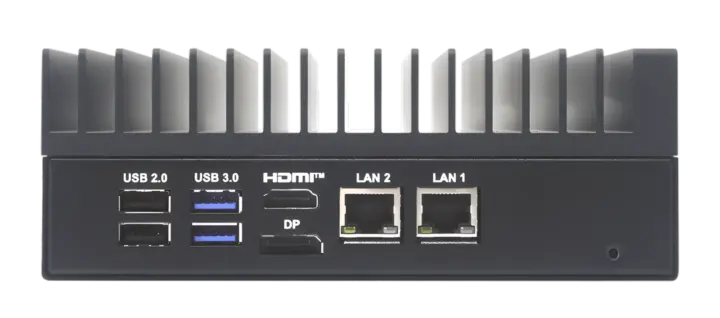
Connectivity is perhaps the most defining characteristic of the EdgeComp MS-U320, reflecting its intended role as a hub for industrial automation and Internet of Things networks. The device features two Ethernet ports, each supporting speeds of 2.5GbE, powered by Intel I226-V and I226-LM controllers. This dual-port configuration allows for network segmentation, where one port can handle internal machine control traffic while the other manages external cloud communication, thereby enhancing security and reducing bandwidth contention. Beyond wired connections, the system includes dedicated M.2 slots for wireless expansion. A Key-E slot is available for optional WiFi and Bluetooth modules, providing local wireless connectivity, while a Key-B slot is reserved for 4G or 5G cellular modules. This cellular capability is particularly valuable for remote installations where wired internet is unavailable or unreliable, enabling continuous data transmission from dispersed industrial sites.
The interface options further distinguish the MS-U320 from standard consumer mini PCs. It includes four COM ports, a feature increasingly rare in modern computing but essential for industrial environments. Two of these ports support the standard RS232 protocol, while the other two are versatile, supporting RS232, RS422, and RS485 standards. This flexibility allows the device to communicate directly with a wide array of legacy industrial equipment, sensors, and controllers that rely on serial communication rather than modern USB or Ethernet protocols. Complementing the serial interfaces are six USB ports: two USB 3.2 Gen2 Type-A ports for high-speed data transfer and four USB 2.0 Type-A ports for connecting peripherals that do not require high bandwidth, such as keyboards, mice, or industrial scanners. This mix ensures that users can connect both modern high-speed devices and older, slower peripherals without the need for external hubs.
Display capabilities are equally impressive for a device of this size, supporting dual 4K outputs via HDMI 2.1 and DisplayPort 1.4. Both interfaces can drive 4K resolution at 60Hz, allowing for the connection of high-resolution monitors for local visualization or digital signage applications. This dual-display support is beneficial for control rooms or kiosks where operators need to view multiple data streams simultaneously. The device’s physical design emphasizes durability and ease of integration. Measuring 167 x 135 x 60 mm and weighing 1.2 kg, it is compact enough to fit into tight spaces yet sturdy enough to withstand industrial handling. The absence of a fan is a critical design choice, eliminating moving parts that could fail due to dust, debris, or vibration. This passive cooling solution relies on the chassis to dissipate heat, which is why the operating temperature range is specified as -20°C to +50°C. This wide thermal tolerance ensures reliable operation in harsh environments, from unheated warehouses to outdoor enclosures.
Power flexibility is another key aspect of the industrial design. The MS-U320 accepts a wide input voltage range of 9-24V DC, accommodating various power supply standards found in industrial settings. A 12V/7.5A adapter is included for standard setups, but the wide input range allows for integration with existing industrial power rails. The device is compatible with major operating systems, including Windows 11, Ubuntu 24.04, and Windows 11 IoT Enterprise. This broad OS support ensures that developers and system integrators can choose the software environment that best fits their application, whether they prefer the stability of Windows IoT for long-term deployments or the flexibility of Linux for custom software stacks. While the pricing for the BIOSTAR EdgeComp MS-U320 has not been announced, its feature set positions it as a versatile tool for edge computing, industrial automation, and IoT gateways, combining modern processing power with the rugged connectivity and reliability demanded by professional environments.
| Attr | Specs | verified |
|---|---|---|
soc | Intel Core 3 304 ou Core 5 320 (Wildcat Lake) | ? unverified |
ram | Jusqu'à 64GB DDR5-6400 (1x SO-DIMM) | ? unverified |
storage | M.2 Key M 2242/2280 NVMe SSD (PCIe Gen4 x2) | ? unverified |
wifi_bluetooth | Optionnel via M.2 Key-E 2230 | ? unverified |
ethernet | 2x 2.5GbE RJ45 (Intel I226-V et I226-LM) | ? unverified |
video | HDMI 2.1 (4K@60Hz) et DisplayPort 1.4 (4K@60Hz) | ? unverified |
usb | 2x USB 3.2 Gen2 Type-A, 4x USB 2.0 Type-A | ? unverified |
serial | 4x COM ports (2x RS232, 2x RS232/422/485) | ? unverified |
power | 9-24V DC (adaptateur 12V/7.5A inclus) | ? unverified |
os | Windows 11, Ubuntu 24.04, Windows 11 IoT Enterprise | ? unverified |
dimensions | 167 x 135 x 60 mm | ? unverified |
weight | 1.2 kg | ? unverified |
temperature_range | -20°C à +50°C | ? unverified |
expansion | M.2 Key-B pour 4G/5G, M.2 Key-E pour WiFi/BT | ? unverified |
Launched in November 2026, the BIOSTAR EdgeComp MS-U320 is an industrial mini PC designed for demanding environments. It is based on the Intel Wildcat Lake platform, offering Core 3 or Core 5 SoC options with dedicated NPU units. This model targets IoT and industrial applications requiring extensive serial connectivity and fanless reliability.
+ Strengths
["- Rich industrial connectivity with four COM ports (RS232/422/485) and dual 2.5GbE Ethernet ports.","- Robust fanless design, operating between -20°C and +50°C with wide-range DC power input (9-24V).","- Network scalability via M.2 slots for WiFi/Bluetooth and 4G/5G modules, supporting dual 4K displays."]
− Weaknesses
["- Storage limited to a single M.2 NVMe slot (PCIe Gen4 x2), restricting RAID or dual-drive capabilities.","- System memory limited to a single SO-DIMM slot, although supporting up to 64GB DDR5.","- Price not announced at launch, making value-for-money assessment difficult for buyers."]
- Retour d'expérience expert expert — expert-microdb
- Après 3 mois de déploiement en atelier, le BIOSTAR MS-U320 tient ses promesses. Le silence total est crucial pour nos opérateurs. La gestion thermique passive gère bien le Core 5 320 à charge moyenne, mais attention : évitez les environnements 45°C sans flux d'air. Les 4 ports COM RS485 sont un gai… — expert-microdb
- Bon retour. Je complète sur le stockage : le M.2 est en PCIe Gen4 x2. Sur nos benchmarks, cela plafonne les vitesses séquentielles, mais reste largement suffisant pour l'IA edge locale (NPU 16 TOPS). Sous Ubuntu 24.04, les pilotes Wildcat Lake sont stables nativement. Un détail : le format compact … — membre-forum
Community feedback and projects
- Discussions Reddit — EdgeComp MS-U320 reddit.com
- Articles CNX Software — EdgeComp MS-U320 cnx-software.com
Content not available yet.
Content not available yet.
Content not available yet.
["- not specified"]
- Configure serial I/O on EdgeComp MS-U320 debutant Apprenez à identifier et tester les quatre ports série COM de votre mini PC industriel pour connecter des capteurs ou automates.
- Configure dual 2.5GbE network on EdgeComp MS-U320 debutant Apprenez à identifier, activer et tester les deux ports Ethernet 2.5GbE de votre mini PC industriel pour une connectivité fiable.
- First boot of the BIOSTAR EdgeComp MS-U320 intermediaire Guide pas à pas pour installer, alimenter et initialiser le mini PC industriel sans ventilateur EdgeComp MS-U320.
- Configuring Serial I/O and GPIO on EdgeComp MS-U320 intermediaire Apprenez à interfacer des capteurs industriels via les ports série RS232/485 et à gérer les entrées-sorties avec Linux sur le module MS-U320.
- Configuring an Industrial Router with EdgeComp MS-U320 intermediaire Transformez le mini PC sans ventilateur en nœud de réseau industriel fiable grâce à ses deux ports 2.5GbE.
- Initial Setup and Diagnostics for BIOSTAR EdgeComp MS-U320 avance Guide avancé pour le câblage industriel, la configuration BIOS et la validation des périphériques critiques du EdgeComp MS-U320.
- Interfacing Industrial Peripherals on the MS-U320 avance Configurez les ports série et GPIO pour connecter des capteurs et afficheurs via Linux sur le EdgeComp MS-U320.
- Deploying an Industrial IoT Gateway with the BIOSTAR EdgeComp MS-U320 avance Configurez le MS-U320 comme nœud de collecte de données robuste en exploitant ses ports série multiples et sa connectivité réseau redondante.
- Configure dual 4K displays with HDMI and DisplayPort debutant Apprenez à connecter et configurer simultanément deux moniteurs 4K sur le MS-U320 via HDMI 2.1 et DisplayPort 1.4.
Code library — examples written for this board
linux-serial-modbus-master.pypythonlinux-gpio-button-monitor.pypythonlinux-network-bonding-2.5gbe.shbashlinux-nvme-benchmark.shbashlinux-ai-npu-inference.pypythonlinux-gpio-serial-multiplexer-6.inobashx86-npu-inference-opencv-7.inopythonindustrial-modbus-tcp-client-8.inopythonx86-4k-dual-display-benchmark-9.inobashx86-nvme-disk-health-monitor-10.inopython