AAEON PICO-PTH4: Pico-ITX Board with Intel Panther Lake SoC
⚡ The essentials in 60 seconds
- soc — Intel Core Ultra 5 325, Core Ultra 7 355, or Core Ultra X7 358H (Panther Lake)
- cpu_cores — Up to 16 cores (4P + 8E + 4LPE) on Core Ultra X7 358H
- ai_performance — Up to 180 TOPS combined (CPU+GPU+NPU) on Core Ultra X7 358H
- ram — Up to 32GB LPDDR5x-7467
- storage — M.2 2280 M-Key (PCIe Gen5 x4) socket for NVMe SSD
- video — HDMI 2.1 up to 3840 x 2160 @ 60 Hz
- On this board : 9 tutorials · 10 code
Imagine a computer no larger than a standard credit card, yet one that carries the computational weight of a modern desktop workstation. This is the conceptual leap embodied by the AAEON PICO-PTH4, a development board that challenges our traditional understanding of size versus performance in embedded computing. Measuring just 100 by 72 millimeters, this board adheres to the Pico-ITX form factor, a standard historically associated with low-power, limited-capability devices. However, the PICO-PTH4 breaks this mold by integrating Intel’s Panther Lake System-on-Chip, marking it as the first board of its kind to bring this advanced silicon architecture into such a compact footprint. To understand the significance of this achievement, one must first grasp what a System-on-Chip, or SoC, represents. Unlike traditional computers where the processor, graphics unit, and memory controllers are separate components on a large motherboard, an SoC integrates these functions into a single, highly efficient package. By placing a Panther Lake SoC on a Pico-ITX board, AAEON has effectively squeezed the brain of a high-end laptop into a space smaller than a deck of cards, opening new possibilities for industrial automation, edge computing, and compact digital signage where space is at a premium but processing power cannot be compromised.
The heart of this board is its processor, available in three distinct variants to suit different performance needs and budgets. The entry-level option is the Intel Core Ultra 5 325, followed by the mid-range Core Ultra 7 355, and culminating in the high-performance Core Ultra X7 358H. For those requiring maximum throughput, the X7 358H variant is particularly noteworthy. It features a hybrid architecture with sixteen cores, divided into four Performance cores, eight Efficient cores, and four Low-Power Efficient cores. This heterogeneous design allows the board to handle heavy computational tasks on the Performance cores while delegating background processes to the more energy-efficient cores, optimizing both speed and power consumption. With boost frequencies reaching up to 4.8 GHz, this processor delivers desktop-class responsiveness. Furthermore, the X7 358H includes an integrated Arc B390 graphics processing unit, enabling it to handle visual workloads that were previously impossible on such small boards. Perhaps most relevant for modern applications is the combined artificial intelligence performance of 180 TOPS, or Tera Operations Per Second. This metric represents the board’s ability to perform AI inference tasks, such as image recognition or natural language processing, locally on the device without needing to send data to the cloud, which enhances privacy and reduces latency.
Memory and storage on the PICO-PTH4 reflect the constraints and optimizations typical of compact embedded systems. The board utilizes up to 32GB of LPDDR5x-7467 memory, which is soldered directly onto the board rather than using removable slots. This design choice saves valuable physical space and improves reliability by eliminating mechanical connectors that could loosen over time due to vibration or thermal cycling. The "LP" in LPDDR5x stands for Low Power, indicating that this memory type is designed to consume less energy than standard desktop DDR5, a crucial feature for devices that may operate in environments with limited cooling or power budgets. For storage, the board provides an M.2 2280 M-Key socket that supports PCIe Gen5 x4 NVMe SSDs. To contextualize this, PCIe Gen5 is the latest generation of the Peripheral Component Interconnect Express standard, offering data transfer speeds that are double those of the previous Gen4 standard. This means that data-intensive applications, such as high-speed data logging or rapid boot times, can benefit from significantly faster read and write operations, ensuring that the storage subsystem does not become a bottleneck for the powerful processor.
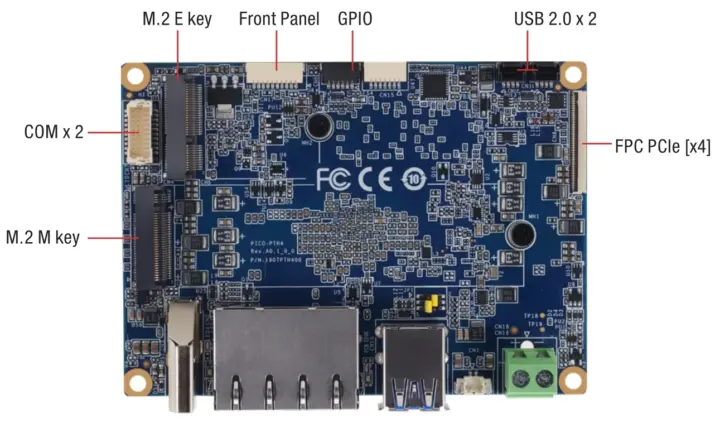
Connectivity is another area where the PICO-PTH4 demonstrates its versatility. It features two Ethernet ports, each capable of 2.5 Gigabit speeds, managed by Intel I226 controllers. In many industrial or networked environments, having two network interfaces allows for network segmentation, where one port handles internal management traffic and the other handles user data, or it can provide redundancy to ensure continuous operation if one cable fails. For wireless connectivity, the board includes an M.2 E-Key slot that can accommodate optional Wi-Fi and Bluetooth modules, allowing users to customize the board for specific deployment scenarios. Video output is handled via an HDMI 2.1 port, which supports resolutions up to 4K at 60 Hz. This ensures that the board can drive modern high-resolution displays, making it suitable for digital signage or control room monitors where crisp visual fidelity is required. The USB configuration includes two external USB 3.2 Gen2 Type-A ports for connecting peripherals like keyboards, mice, or external drives, alongside two internal USB 2.0 headers for connecting built-in devices such as touchscreens or barcode scanners that do not require the high bandwidth of USB 3.0.
Beyond standard consumer interfaces, the PICO-PTH4 is equipped with a suite of industrial-grade connectors that highlight its intended use in professional applications. It includes internal headers for GPIO, which stands for General Purpose Input/Output, allowing the board to interact with external sensors, actuators, and other electronic components. This is essential for automation tasks where the computer must control physical machinery. Additionally, the board supports SMBus and I2C protocols, which are communication standards commonly used in embedded systems to connect low-speed peripherals like temperature sensors or battery monitors. For legacy industrial equipment, the board provides two RS-232/422/485 serial ports. These serial interfaces are vital in factories and laboratories where older machines and instruments still rely on serial communication for data exchange. The inclusion of a TPM 2.0 chip further underscores the board’s security focus, providing hardware-based encryption keys and secure boot capabilities to protect sensitive data and prevent unauthorized access.
Powering this compact powerhouse is a 12V DC input, available via a 2-pin Phoenix connector or a lockable DC jack. The Phoenix connector is a screw-terminal block that ensures a secure, vibration-resistant connection, which is critical in industrial settings where loose cables can cause system failures. The lockable DC jack offers a similar level of security for standard power adapters. The board runs on Windows 11 64-bit and Ubuntu 26.04, indicating strong support for both proprietary and open-source operating systems. The mention of Linux kernel 7.0.0 suggests that the board is supported by very recent software developments, ensuring compatibility with the latest drivers and security patches. As of November 2026, mass production has begun, with launch prices set at 1288 USD for the Core Ultra 5 model, 1456 USD for the Core Ultra 7, and 3065 USD for the high-end Core Ultra X7 358H. These prices reflect the premium nature of the technology, positioning the PICO-PTH4 not as a hobbyist toy, but as a serious tool for engineers and developers who need to integrate high-performance computing into space-constrained environments. The AAEON PICO-PTH4 thus represents a convergence of miniaturization, high performance, and industrial robustness, offering a glimpse into the future of edge computing where powerful AI and processing capabilities are embedded directly into the devices around us.
| Attr | Specs | verified |
|---|---|---|
soc | Intel Core Ultra 5 325, Core Ultra 7 355, or Core Ultra X7 358H (Panther Lake) | ? unverified |
cpu_cores | Up to 16 cores (4P + 8E + 4LPE) on Core Ultra X7 358H | ? unverified |
ai_performance | Up to 180 TOPS combined (CPU+GPU+NPU) on Core Ultra X7 358H | ? unverified |
ram | Up to 32GB LPDDR5x-7467 | ? unverified |
storage | M.2 2280 M-Key (PCIe Gen5 x4) socket for NVMe SSD | ? unverified |
video | HDMI 2.1 up to 3840 x 2160 @ 60 Hz | ? unverified |
ethernet | 2x 2.5GbE RJ45 ports via Intel I226 controllers | ? unverified |
usb | 2x USB 3.2 Gen2 Type-A, 2x USB 2.0 via internal header | ? unverified |
expansion | M.2 2230 E-Key (PCIe 4.0 x1/USB 2.0), FPC PCIe 3.0 x4 connector | ? unverified |
serial | 2x RS-232/422/485 box header | ? unverified |
power | 12V DC input via 2-pin Phoenix connector or lockable DC jack | ? unverified |
dimensions | 100 x 72 mm (Pico-ITX form factor) | ? unverified |
os | Windows 11 64-bit and Ubuntu 26.04 (Linux kernel 7.0.0) | ? unverified |
security | TPM2.0 chip | ? unverified |
The AAEON PICO-PTH4 was introduced as the world's first Pico-ITX board (100x72mm) featuring an Intel Panther Lake SoC. Mass production of this series, available in three Core Ultra processor variants, began in November 2026.
+ Strengths
["World's first Pico-ITX board equipped with an Intel Panther Lake SoC","Combined AI performance up to 180 TOPS and Arc B390 GPU on the X7 358H variant","Robust network connectivity with two 2.5GbE Ethernet ports (Intel I226)"]
− Weaknesses
["Soldered LPDDR5x memory, limiting post-purchase scalability","High launch prices, reaching $3065 for the high-end version","Storage limited to a single M.2 2280 slot"]
- Retour d'expérience expert expert — expert-microdb
- J'ai testé la PICO-PTH4 en usine. La densité est folle : 100x72mm avec un Ultra X7 358H. 180 TOPS IA et GPU Arc B390 dans ce format, c'est inédit. Attention, la RAM LPDDR5x est soudée, choisissez bien vos 32Go dès l'achat. Le M.2 Gen5 est rapide mais chauffe. À 3065$, c'est cher, mais pour de l'edg… — expert-microdb
- Merci pour le retour. Le prix de 3065$ pour le X7 me fait hésiter, surtout si la RAM n'est pas modifiable. L'Ultra 5 à 1288$ semble plus raisonnable pour de l'automation. Je note les 2 ports série et GPIO, essentiels pour mes anciens automates. Le HDMI 2.1 à 60Hz suffit-il pour vos écrans de contrô… — membre-forum
Community feedback and projects
- Discussions Reddit — PICO-PTH4 reddit.com
- Articles CNX Software — PICO-PTH4 cnx-software.com
Content not available yet.
Content not available yet.
Content not available yet.
["not specified"]
- Initial Setup of the PICO-PTH4 debutant Guide pas à pas pour assembler, alimenter et démarrer pour la première fois la carte Pico-ITX PICO-PTH4.
- Connect an IO device to PICO-PTH4 debutant Apprenez à utiliser les connecteurs internes GPIO et série de la carte PICO-PTH4 pour interfacer des capteurs ou afficheurs.
- Set up reliable storage and network on PICO-PTH4 debutant Apprenez à installer un SSD NVMe et configurer les deux ports Ethernet 2.5GbE sur la carte PICO-PTH4 pour un usage réseau ou NAS léger.
- PICO-PTH4 Getting Started: Assembly and First Boot intermediaire Guide étape par étape pour assembler, alimenter et démarrer la carte PICO-PTH4 Panther Lake.
- Configuring GPIO I/O on PICO-PTH4 intermediaire Apprenez à utiliser les connecteurs internes GPIO de la PICO-PTH4 pour interfacer des capteurs et actionneurs via Linux.
- Configuring a Compact NAS with the PICO-PTH4 intermediaire Exploitez les ports 2.5GbE et le stockage NVMe Gen5 du PICO-PTH4 pour créer un serveur de fichiers haute performance.
- Initial connection and booting of the PICO-PTH4 avance Guide avancé pour assembler, alimenter et configurer la PICO-PTH4 Panther Lake avec ses composants critiques.
- GPIO and I2C Control on PICO-PTH4 avance Configurez les entrées-sorties GPIO et le bus I2C de la PICO-PTH4 pour interfacer des capteurs ou afficheurs via les connecteurs internes.
- Deploying a High-Performance Software Router on the PICO-PTH4 avance Configurez la PICO-PTH4 comme routeur logiciel dédié en exploitant ses deux ports Ethernet 2.5GbE et son stockage NVMe Gen5.
Code library — examples written for this board
gpio-led-blink-python.pyPythoni2c-sensor-temp.pyPythonnetwork-monitor-eth.pyPythonnvme-storage-bench.shBashai-inference-openvino.pyPythongpio-led-control-python.pyPythonrs232-serial-communication.pyPythonhigh-speed-storage-benchmark.shBashnetwork-monitoring-25gbe.pyPythonai-inference-openvino.pyPython